How do Glow in the Dark Signs Work and What Materials are Used?
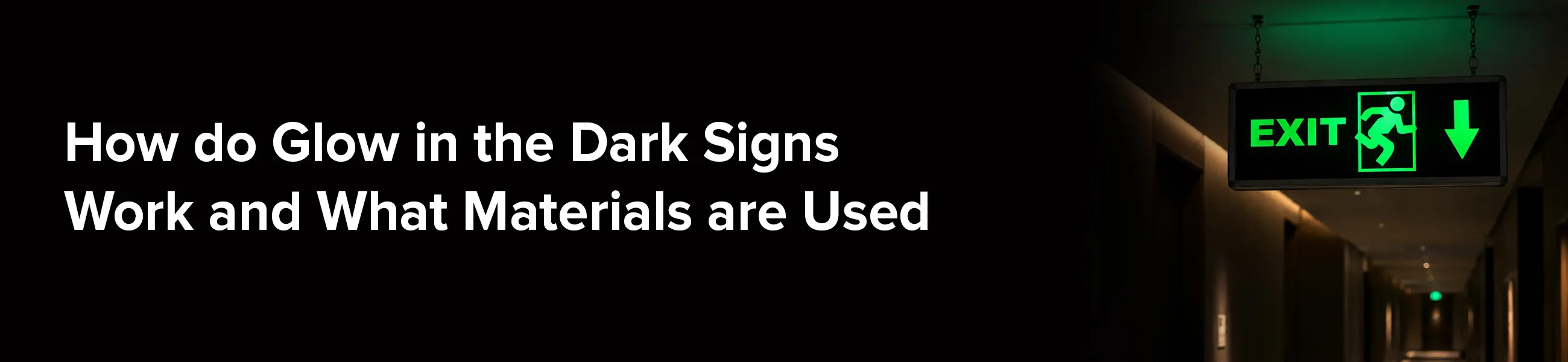
Glow in the dark signs work by absorbing ambient light — from natural sunlight or artificial indoor lighting — and slowly releasing that stored energy as visible light in darkness. The material responsible is called a phosphor, and the most widely used modern phosphor in glow in the dark signs is strontium aluminate, which produces a bright, long-lasting glow that outlasts the older zinc sulphide phosphors it replaced. For businesses in Dubai, Abu Dhabi, and across the UAE, glow in the dark signs — more accurately called photoluminescent signs — are used for emergency exit marking, escape route signs, and safety wayfinding in commercial buildings, hotels, hospitals, and industrial facilities.
This guide explains exactly how glow in the dark signs work, what materials they use, how long they glow, and where and why they are used across UAE commercial environments.
What Is a Glow in the Dark Sign?
A glow in the dark sign — technically called a photoluminescent sign or phosphorescent sign — is a safety or informational sign produced using a substrate or coating containing photoluminescent pigment. The sign absorbs energy from ambient light sources during normal conditions and emits that stored energy as visible light in the absence of ambient illumination — typically during a power failure, fire emergency, or low-light scenario.
Photoluminescent signs are distinct from:
- Electrically illuminated signs — which require a power connection and active electrical supply to produce light
- Retroreflective signs — which reflect external light sources back toward the viewer but do not produce light independently
- Fluorescent signs — which appear bright under UV light but do not glow in complete darkness
Glow in the dark signs produce their own light, independently, without any electrical connection — which is precisely why they are used for emergency egress, evacuation route marking, and safety compliance in commercial buildings across the UAE.
The Science: How Do Glow in the Dark Signs Work?
Photoluminescence — The Core Mechanism
Photoluminescence is the process by which certain materials absorb photons (light energy) from an external source and then re-emit those photons as visible light over a period of time after the original light source is removed.
The process works in three stages:
Stage 1 — Excitation (Charging)
When ambient light — sunlight, LED lighting, fluorescent tube lighting, or any standard indoor lighting — strikes the photoluminescent material in the sign, the photons in the light transfer energy into the electrons within the phosphor crystal structure. These electrons are excited to a higher energy state and temporarily stored there.
Stage 2 — Storage
Unlike fluorescence — which releases light almost instantaneously — photoluminescent materials store the excited electrons in what physicists call "trap states" within the crystal structure. These trap states hold the energy for an extended period rather than releasing it immediately.
Stage 3 — Emission (Afterglow)
When the ambient light is removed or significantly reduced — during a power failure, in a windowless room, or in smoke-filled emergency conditions — the excited electrons gradually fall back to their ground energy state, releasing the stored energy as photons of visible light. This is the glow that is visible in darkness.
The duration and intensity of the glow depends on:
- The type of phosphor used
- The thickness and concentration of the phosphor layer
- The intensity and duration of the preceding charge (excitation) period
- The ambient temperature — higher temperatures accelerate the decay of the glow
The Two Phosphors: Zinc Sulphide vs Strontium Aluminate
Understanding the difference between the two main photoluminescent phosphors explains the significant performance gap between older and newer glow in the dark signs.
Zinc Sulphide (ZnS) — The Original Phosphor
Zinc sulphide was the primary phosphor in glow in the dark products for most of the 20th century. It produces a recognisable blue-green glow but has significant limitations:
- Short afterglow duration: Typically 30 minutes to 2 hours of visible emission after a full charge
- Lower initial brightness: The peak emission is modest compared to strontium aluminate
- Requires UV light to charge effectively: Zinc sulphide charges better under ultraviolet light than standard indoor white light
- Degrades over time: ZnS products yellow and lose photoluminescent efficiency with age
Zinc sulphide glow in the dark products are still available at lower price points but are not appropriate for safety-critical signage applications — the emergency egress scenario requires signs that glow for longer than a 30-minute window.
Strontium Aluminate (SrAl₂O₄) — The Modern Standard
Strontium aluminate, activated with europium and dysprosium rare earth elements, is the photoluminescent material used in modern glow in the dark signs for safety compliance in the UAE and internationally.
Its properties represent a fundamental improvement over zinc sulphide:
- Significantly longer afterglow: Depending on the formulation and pigment concentration, strontium aluminate signs glow visibly for 8–24 hours after a standard charge
- Higher initial brightness: Peak emission intensity is dramatically higher than ZnS — the sign is genuinely bright in the first minutes of darkness rather than faintly visible
- Charges efficiently under white LED and fluorescent lighting: The standard lighting in UAE commercial buildings is sufficient to charge strontium aluminate signs fully
- Long operational lifespan: Quality strontium aluminate photoluminescent signs maintain their performance for 10–25+ years of charging and discharging cycles
Quick summary: Modern glow in the dark signs work because strontium aluminate phosphor absorbs standard indoor ambient light efficiently, stores the energy in trap states within its crystal structure, and releases it as a sustained, bright afterglow lasting 8–24 hours — fully independent of electrical power.
What Materials Are Used in Glow in the Dark Signs?
The construction of a photoluminescent sign involves multiple material layers — each contributing to the sign's performance, durability, and compliance with safety standards.
1. Photoluminescent Base Film or Panel
The primary photoluminescent layer is the strontium aluminate pigment suspended in a polymer carrier — either:
- Photoluminescent film: A flexible or semi-rigid polymer film with strontium aluminate pigment embedded in or printed onto the substrate. Available in roll form for cutting to sign shapes or in pre-cut sign-sized sheets.
- Photoluminescent rigid panel: A rigid PVC, aluminium, or composite substrate coated or laminated with photoluminescent material. More robust for permanent installation in high-traffic areas.
- Photoluminescent tape: Narrow film format used for step-edge marking, handrail identification, and door frame outlining in emergency egress routes.
2. Printed Safety Symbol Layer
ISO 7010 compliant emergency exit symbols, directional arrows, and text are screen-printed or digitally printed over the photoluminescent base. These printed elements appear as normal coloured graphics in ambient light — the standard green-and-white emergency exit colour coding — and continue to be visible in darkness through the glow of the underlying photoluminescent layer.
3. Protective Laminate
A clear protective laminate is applied over the printed surface to:
- Protect the printed safety symbols from abrasion, cleaning chemicals, and moisture
- Extend the overall service life of the sign
- Provide a surface that can be cleaned without degrading the photoluminescent performance beneath
4. Backing or Mounting Layer
Depending on the installation method, the sign is backed with:
- Adhesive backing — self-adhesive for direct application to wall, glass, or floor surfaces
- Rigid substrate — for signs mounted with screws, standoffs, or into sign frames
- Magnetic backing — for removable or relocatable installation on metal surfaces
How Long Do Glow in the Dark Signs Glow?
Glow duration is one of the most practically important questions about how glow in the dark signs work — particularly for safety compliance applications in the UAE.
| Phosphor Type | Peak Brightness | Visible Glow Duration | Charge Required |
|---|---|---|---|
| Zinc sulphide (ZnS) | Low | 30 minutes – 2 hours | UV light preferred |
| Strontium aluminate (SrAl₂O₄) — standard | High | 8–12 hours | White light (LED, fluorescent) |
| Strontium aluminate — high-performance | Very high | 12–24 hours | White light (LED, fluorescent) |
For UAE safety compliance: The ISO 7010 and DCD (Dubai Civil Defence) standards require that emergency exit and escape route signs remain visible and legible for the duration of an evacuation scenario. In large commercial buildings in Dubai and Abu Dhabi, evacuation may take several hours — high-performance strontium aluminate signs with 12–24 hour afterglow provide the appropriate safety margin.
Charging time for a full glow: A standard strontium aluminate photoluminescent sign reaches near-maximum charge after approximately 10–60 minutes of exposure to adequate ambient lighting (500 lux or above — the standard illuminance level in most commercial office lighting in the UAE). Signs in locations with continuous ambient lighting (constantly lit corridors, offices) are effectively always at full charge.
UAE Regulatory Standards for Glow in the Dark Signs
ISO 7010
The international standard that defines the symbols, colours, shapes, and meanings of safety signs — including the green-and-white emergency exit running figure and escape route directional arrows that appear on photoluminescent signs.
DCD (Dubai Civil Defence) Requirements
Dubai Civil Defence specifies photoluminescent emergency exit and escape route signage as an approved alternative to electrically illuminated emergency signs in commercial buildings, hotels, hospitality venues, and certain industrial facilities. DCD requirements include:
- Sign placement at every exit door, stairwell entry, and directional change in an escape route
- Signs must be visible and legible at the required distances under emergency conditions
- Signs must be produced from materials that maintain photoluminescent performance for the approved service life
ADCD (Abu Dhabi Civil Defence) Requirements
Abu Dhabi Civil Defence follows similar requirements aligned with NFPA (National Fire Protection Association) and ISO standards, with photoluminescent wayfinding and egress marking specified for commercial, healthcare, and industrial facilities.
ISO 16069 (Photoluminescent Guidance Systems)
The specific ISO standard governing photoluminescent guidance systems — covering the performance requirements for photoluminescent signs and wayfinding in buildings, including minimum initial luminance and decay rates.
Where Glow in the Dark Signs Are Used in Dubai and the UAE
Photoluminescent glow in the dark signs are used across every commercial building category in Dubai, Abu Dhabi, and the wider UAE:
Commercial Towers and Office Buildings
Every stairwell, fire exit, emergency exit door, and escape route corridor in commercial towers across Business Bay, DIFC, and Sheikh Zayed Road requires photoluminescent emergency exit signs and directional wayfinding. Photoluminescent signs supplement or replace electrically illuminated emergency signs — providing egress visibility if the building's emergency lighting system fails or is overwhelmed by smoke.
Hotels and Hospitality
Hotels across Dubai — on the Palm Jumeirah, JBR, and Downtown Dubai — are required to have photoluminescent exit and escape route signs in all guest corridors, stairwells, car parks, and service areas. Hotel guests navigating an unfamiliar building during an emergency depend entirely on clearly visible escape route marking — photoluminescent signs provide this without any dependency on electrical power.
Hospitals and Healthcare Facilities
Healthcare facilities in Dubai Healthcare City and Abu Dhabi's hospital districts have complex floor plans where emergency egress is challenging for patients, visitors, and staff unfamiliar with the layout. Photoluminescent guidance systems — including step-edge marking, door frame outlining, and directional floor signs — supplement overhead exit signs to create a complete low-level guidance system visible below smoke.
Shopping Malls and Retail
Dubai Mall, Mall of the Emirates, and similar large-footfall retail environments are required to mark every emergency exit and escape route with photoluminescent signs — providing egress guidance to thousands of simultaneous visitors in a smoke-impaired or power-failure scenario.
Industrial and Warehouse Facilities
Industrial facilities in Jebel Ali, KIZAD (Khalifa Industrial Zone), and other UAE industrial areas use photoluminescent signs for escape route marking, hazard identification, and emergency equipment location — environments where the combination of machinery noise, dust, and potential smoke significantly reduces visibility during an emergency.
Marine and Offshore
Marine vessels and offshore platforms operating under UAE maritime authority are required to carry photoluminescent escape route signs, lifeboat location signs, and emergency equipment identification — environments where electrical failure is a realistic scenario and alternative egress guidance is critical.
Benefits of Glow in the Dark Signs for UAE Businesses
No Electrical Dependency
Photoluminescent signs work regardless of electrical supply — they are fully functional during complete power failures, the scenarios where emergency egress guidance is most needed. Electrically illuminated emergency signs, while standard in most buildings, depend on backup battery systems that have a finite operational life. Photoluminescent signs have no such dependency.
Long Service Life
High-quality strontium aluminate photoluminescent signs maintain their photoluminescent performance for 10–25+ years — significantly outlasting the battery systems in electrically illuminated emergency signs. This long service life reduces ongoing maintenance and replacement costs for UAE building operators.
Low Maintenance
Photoluminescent signs require no wiring, no batteries, no power supply, and no scheduled electrical maintenance. In large buildings with dozens or hundreds of emergency signs, eliminating electrical maintenance across the photoluminescent sign inventory represents a meaningful operational cost saving.
Regulatory Compliance
Photoluminescent signs are approved under DCD, ADCD, ISO 7010, and ISO 16069 standards for commercial building emergency egress marking in the UAE — using them provides a straightforward path to regulatory compliance for building owners and facilities managers.
Best Practices for Glow in the Dark Signs in UAE Buildings
- Ensure adequate ambient lighting at sign positions. Photoluminescent signs must be regularly exposed to adequate ambient light to maintain a full charge — signs installed behind opaque fixtures, inside enclosed cabinets, or in areas where lighting is frequently switched off may not charge adequately. A minimum of 500 lux continuous illuminance at the sign surface is the general requirement.
- Install signs at low level as well as overhead. In a smoke-filled emergency scenario, visibility above waist height is rapidly obscured. Low-level photoluminescent escape route signs — at 15–50 cm from the floor — remain visible in smoke conditions where overhead signs are not. UAE fire safety frameworks increasingly recognise this in their guidance for large public buildings.
- Use photoluminescent floor path markings in addition to wall signs. Step-edge markers, directional floor arrows, and continuous floor-level guidance strips supplement overhead photoluminescent signs for a complete low-visibility egress system — particularly important in UAE hotels, hospitals, and large retail environments.
- Inspect photoluminescent signs annually. While photoluminescent signs require no electrical maintenance, they should be inspected annually for surface damage, fading of the ISO 7010 printed symbols, and cleaning of any dust or grime that reduces the sign's light absorption. A sign that cannot absorb ambient light cannot charge effectively.
- Specify Grade 1 or Grade 2 photoluminescent material for safety-critical applications. ISO 16069 classifies photoluminescent guidance system materials by performance grade — Grade 1 produces a higher initial luminance and longer visible glow duration than Grade 2. For emergency egress applications in large commercial buildings in Dubai and Abu Dhabi, Grade 1 specification provides the appropriate safety margin.
Expert Tips for UAE Building Managers and Facilities Teams
- Do not place photoluminescent signs behind opaque covers or in recessed fittings — the sign must have direct exposure to ambient light to charge correctly. A sign installed inside a semi-opaque diffuser or on a surface that receives only 50 lux rather than 500 will not charge to a usable level.
- Consider photoluminescent signs for car park emergency egress — car parks in Dubai's commercial towers and mall complexes are low-ambient-light environments even during normal operation, making them an important application for photoluminescent step-edge marking and directional signs.
- Coordinate photoluminescent sign installation with DCD inspection. In new commercial building fit-outs in Dubai, photoluminescent emergency sign installation should be coordinated with the DCD inspection schedule — non-compliant or absent emergency signage is a common finding in DCD fit-out inspections and can delay occupancy approval.
Where to Source Glow in the Dark Signs in Dubai and the UAE
For building managers, facilities teams, HSE officers, and safety consultants sourcing photoluminescent glow in the dark signs across Dubai, Abu Dhabi, and the UAE, Deluxe Printing produces ISO 7010 compliant photoluminescent emergency exit signs, directional signs, escape route markers, and step-edge tapes in strontium aluminate materials — with DCD and ADCD compliant specifications, bilingual English and Arabic text options, and fast production and delivery to commercial, hospitality, healthcare, and industrial facilities across the UAE. With over 25 years of commercial signage production experience in Dubai, the Deluxe team advises on sign placement, specification grade, and compliance requirements for specific building types.
Key Takeaways
- Glow in the dark signs work by absorbing ambient light into a photoluminescent phosphor — primarily strontium aluminate in modern signs — storing that energy in excited electron states, and releasing it as visible light in darkness
- Strontium aluminate phosphor (SrAl₂O₄) is the modern standard for safety-grade photoluminescent signs — producing a glow that lasts 8–24 hours after a standard charge from normal indoor lighting, far outperforming the older zinc sulphide (ZnS) phosphor
- No electrical connection is required — photoluminescent signs function completely independently of power supply, making them the most reliable emergency egress sign in power failure scenarios
- Charging occurs under standard indoor lighting — LED and fluorescent office lighting at 500 lux or above is sufficient to fully charge strontium aluminate signs during normal building occupancy
- ISO 7010, ISO 16069, DCD, and ADCD standards govern the use of photoluminescent signs in UAE commercial buildings — Grade 1 performance is recommended for emergency egress in large commercial, hospitality, and healthcare buildings
- Low-level photoluminescent installation (floor-level signs and step-edge markers) is critical for smoke-impaired evacuation scenarios where overhead sign visibility is compromised
- Service life of 10–25+ years with no electrical maintenance makes strontium aluminate photoluminescent signs the most cost-effective long-term emergency egress solution for UAE buildings
Frequently Asked Questions
Contact Deluxe Printing
- Al Qusais Industrial Area 2 is located in Dubai, UAE
- Call us on +971 4272 5202
- Email: print@dlxprint.com