What are the Best Materials Used for Custom Beach Towels?
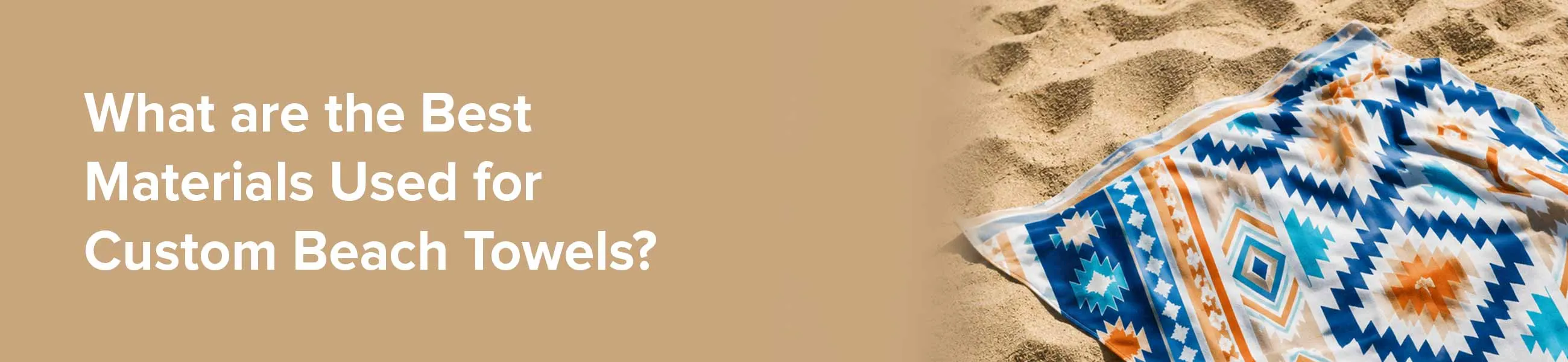
The best materials for custom beach towels are 100% cotton (particularly Turkish and Egyptian cotton), microfibre polyester, and cotton-polyester blends. For custom branding in Dubai and the UAE — where pool decks, beach clubs, hotels, and outdoor leisure environments are year-round — each material offers a different balance of absorbency, print quality, weight, and drying speed. Cotton delivers superior softness and absorbency. Microfibre is the lightest and fastest-drying option. Cotton-polyester blends provide a practical middle ground between print clarity and comfort.
This guide covers beach towel materials in detail — comparing their properties, advantages, print compatibility, and best-fit use cases for businesses, hotels, and brands across Dubai and the UAE.
What Is a Beach Towel Material?
Beach towel material refers to the fibre composition and weave structure of the textile used to produce a beach or pool towel. The material determines:
- How much water the towel absorbs and how quickly
- How soft it feels against the skin
- How well it holds printed designs and brand colours
- How quickly it dries in outdoor conditions
- How durable it is across repeated washing and commercial use
For businesses ordering custom beach towels in Dubai and the UAE — whether for hotel pools, beach clubs, resort guest amenities, corporate gifting, or branded promotional campaigns — the material specification is the foundational decision that affects every other quality attribute of the finished towel.
Why Beach Towel Material Matters for Brands in Dubai and the UAE
Dubai’s beach and pool environment is specific in ways that affect material performance directly. Towels are exposed to:
- Intense UV sunlight — which can fade dye-printed fabrics if the ink or dye is not bonded correctly to the fibre
- Saltwater and chlorinated pool water — which accelerates fabric degradation in lower-quality materials
- High ambient temperatures — which make the towel's drying speed and weight against wet skin more important than in cooler climates
- Frequent, commercial-grade washing — in hotel and resort environments where towels are laundered daily at high temperatures
For hotels, beach clubs, and hospitality brands across Dubai, Abu Dhabi, and Ras Al Khaimah choosing beach towel material is therefore not just a comfort decision — it is a durability and cost-of-ownership decision that affects how long the branded towels remain in service before replacement.
Quick summary: The right beach towel material in Dubai depends on the context — premium cotton for guest-facing luxury hospitality; microfibre for portable, lightweight giveaway and gifting applications; cotton-polyester blends for value-driven branded merchandise at scale.
The Main Beach Towel Materials — Compared
1. 100% Cotton Beach Towels
Cotton is the benchmark beach towel material for comfort and absorbency. The natural fibre structure of cotton creates a highly hydrophilic (water-attracting) surface — meaning the towel absorbs water quickly and holds a significant volume relative to its weight.
Turkish Cotton
Turkish cotton is grown in the Aegean region of Turkey and is distinguished by its long, fine fibres — a characteristic known in the textile industry as a high staple length. Long fibres produce a yarn that is stronger, softer, and more lustrous than standard cotton, and a woven towel that becomes progressively softer with each wash rather than degrading.
Key properties for beach towel use in Dubai:
- High absorbency — ideal for pool and beach use where guests are wet frequently
- Becomes softer with repeated washing — important for long-service commercial towels
- Lightweight for its absorbency — less bulk than Egyptian cotton at equivalent quality
- Compatible with reactive dye printing — produces vivid, wash-resistant colour
Turkish cotton is the most widely specified beach towel material across Dubai's luxury hotel and resort sector — used extensively in five-star properties on the Palm Jumeirah, JBR, and Jumeirah Beach.
Egyptian Cotton
Egyptian cotton is similarly distinguished by its long staple fibres, grown in the Nile Delta region of Egypt. It is marginally heavier and denser than Turkish cotton, producing a plush, thick towel that feels luxurious to touch and provides very high absorbency.
Key properties for beach towel use:
- Very high absorbency — the premium choice for pool-side guest towels
- Dense, heavyweight feel — communicates luxury at the point of handover
- Excellent colour retention with reactive dye printing
- Higher weight per unit than Turkish cotton — slightly heavier to carry and slower to dry
Egyptian cotton beach towels are the preferred choice for ultra-luxury hospitality brands in Dubai and Abu Dhabi where the towel's weight and feel are part of the brand experience.
Standard Cotton (Ring-Spun and Combed)
Standard cotton beach towels use shorter fibre yarns than Turkish or Egyptian alternatives — producing a more affordable, functional towel that is widely used for branded promotional giveaways, event towels, and mid-tier hospitality applications in the UAE.
Ring-spun and combed cotton variants offer improved softness over basic cotton by removing short fibres during the yarn production process — producing a smoother, more consistent fabric surface that prints more cleanly.
Key properties:
- Good absorbency — adequate for most beach and pool applications
- Cost-effective per unit — suited to high-volume branded orders
- Prints well with reactive dye — accurate colour reproduction
- Softens with washing but does not improve to the degree Turkish or Egyptian cotton does
2. Microfibre Beach Towels
Microfibre is a synthetic material — most commonly 100% polyester or a polyester-nylon blend — produced by splitting individual fibres into strands far thinner than human hair. The resulting fabric has an enormous surface area relative to its weight, giving it exceptional water absorption despite being significantly lighter and thinner than cotton.
Key properties for beach towel use in Dubai:
- Very fast drying — microfibre releases absorbed water rapidly, making it practical in outdoor conditions where repeated wet-dry cycles occur across a single beach or pool day
- Lightweight and compact — a microfibre beach towel folds to a fraction of the size and weight of a cotton equivalent, making it the preferred material for travel, outdoor leisure, and portable branded gift towels
- High print quality — dye-sublimation printing on polyester microfibre produces photographic-quality, full-colour prints with vivid colour saturation that cotton cannot match
- Non-fading under UV — dye-sublimated prints on polyester are bonded into the fibre at the molecular level, making them significantly more UV-resistant than reactive dye prints on cotton
Challenges of microfibre for beach towel use:
- Less immediately soft against skin than premium cotton — though quality improves with washing
- Can generate static in dry conditions
- Less effective at absorbing sand compared to cotton pile structures
Microfibre beach towels are the most popular material for branded beach towels used as corporate giveaways, event gifts, and promotional merchandise in Dubai — particularly when the towel needs to pack small, travel light, and carry full-colour artwork.
3. Cotton-Polyester Blend Beach Towels
Cotton-polyester blends combine natural and synthetic fibres in varying ratios — typically 70/30 or 80/20 cotton-to-polyester — to produce a beach towel material that balances the comfort of cotton with the durability and print quality of polyester.
Key properties:
- Better colour retention across repeated commercial washing than 100% cotton
- Faster drying than 100% cotton
- Good absorbency — cotton fibre component maintains water absorption
- More dimensionally stable than pure cotton — less shrinkage across the towel's service life
- Prints well with reactive dye or digital print — though not to the full-colour saturation of dye-sublimation on 100% polyester
Cotton-polyester blends are a practical choice for branded beach towels in Dubai hotel and resort environments where the towels will be commercially laundered frequently and where colour consistency across the full towel inventory needs to be maintained over time.
4. Bamboo Cotton Beach Towels
Bamboo-derived rayon or bamboo-cotton blends are an increasingly requested beach towel material in Dubai's hospitality and gifting market, driven by the growth of eco-conscious gifting programmes and sustainability-focused hotel and resort brands.
Key properties:
- Naturally antibacterial — bamboo fibre has inherent antimicrobial properties
- Very soft — bamboo rayon produces a silky-smooth fabric surface
- Naturally odour-resistant — useful for towels in extended outdoor use
- Biodegradable — aligned with sustainability commitments and ESG gifting programmes
- Absorbs water well — though typically less efficient than long-staple cotton at equivalent weights
Bamboo cotton beach towels are popular for luxury corporate gifting in Dubai, eco-resort amenity programmes, and branded gifting campaigns aligned with environmental responsibility.
Weave Structure — How It Affects Beach Towel Performance
Beyond the fibre type, the way a beach towel is woven significantly affects its texture, absorbency, and print compatibility.
Terry Weave
Terry weave is the standard towel construction — loops of yarn are woven into the fabric to create a pile surface on one or both faces. The loops create additional surface area for water absorption, making terry weave towels highly absorbent.
Considerations for branding: The looped surface of terry is less ideal for highly detailed full-colour printing — it is better suited to embroidery or simple screen-printed designs.
Velour Beach Towels
Velour is a variation of terry weave where the loops on one face are sheared flat — creating a smooth, velvety surface that feels soft against the skin and provides an excellent surface for printed designs.
Considerations for branding: The flat velour face accepts reactive dye printing and digital print with higher detail and colour clarity than standard terry — making velour the preferred construction for custom beach towels with logo-heavy or full-colour printed designs in Dubai.
Flat Weave / Fouta Towels
Flat weave beach towels have no pile structure — they are woven as a flat textile, similar to a lightweight blanket. They are much thinner and lighter than terry or velour, dry faster, and pack more compactly.
Considerations for branding: Flat weave accepts digital and reactive dye printing with excellent colour reproduction. Popular for promotional beach towels and travel-ready branded gifts in the UAE.
Printing Methods and Their Compatibility With Beach Towel Materials
The material of a beach towel directly determines which printing methods produce the best results.
| Material | Reactive Dye | Dye-Sublimation | Screen Print | Embroidery |
|---|---|---|---|---|
| 100% Cotton (Terry/Velour) | Excellent | Not suitable | Good | Excellent |
| 100% Microfibre (Polyester) | Not suitable | Excellent | Limited | Limited |
| Cotton-Polyester Blend | Good | Limited | Good | Good |
| Bamboo Cotton | Good | Not suitable | Good | Good |
Quick summary:
- Cotton towels print best with reactive dye — the dye bonds with the natural cotton fibre for colour that is wash-resistant and vibrant
- Microfibre/polyester towels print best with dye-sublimation — the process infuses the dye directly into the polyester fibre for photographic-quality, UV-resistant full-colour prints
- Embroidery suits any material but is particularly valued on cotton towels for logo applications where a raised, premium brand mark is appropriate
Best Practices for Choosing Beach Towel Material for Branded Use in Dubai
- Match the material to the end use. A lightweight microfibre towel is the right choice for a portable corporate giveaway or travel set. A heavyweight Turkish cotton towel is the right choice for a hotel pool deck or luxury client gift.
- Consider the washing frequency. For hotel and resort environments in Dubai where towels are commercially laundered daily, cotton-polyester blends and Turkish cotton offer better dimensional stability and colour retention across repeated high-temperature washing than standard cotton or microfibre.
- Specify the weight in GSM (grams per square metre). Beach towel weight is measured in GSM — a higher GSM indicates a heavier, more absorbent towel. For reference: 400–500 GSM is standard for promotional towels; 500–600 GSM suits mid-tier hospitality; 600–800 GSM is the range for luxury hotel and resort towels in Dubai.
- Confirm print compatibility before finalising the material. If the brand design requires full-colour photographic-quality printing, microfibre (polyester) with dye-sublimation is the correct specification. If the design is a simple logo on a rich cotton towel, reactive dye on cotton velour or terry produces the best result.
- Consider the UAE climate. Towels that dry slowly in humidity are less practical for Dubai's beach and pool environments than lighter microfibre or flat-weave alternatives — particularly for guest-use towels where fast drying between laundering cycles is important.
Expert tip: For hospitality brands in Dubai ordering beach towels for long-term commercial use, specify a GSM of at least 500 and a 100% cotton or Turkish cotton construction — these towels withstand frequent commercial laundering while maintaining softness and colour integrity over a longer service life, reducing the replacement frequency compared to lighter-weight alternatives.
Practical Examples — Beach Towel Material for Different Dubai Use Cases
Five-Star Hotel Pool Deck (Dubai Marina)
Best material: Turkish cotton velour (600–700 GSM)
Branding: Embroidered logo on the towel corner
Reason: Premium softness and absorbency aligned with the guest experience standard. Embroidered logo maintains quality through daily commercial laundering.
Corporate Beach Gifting Campaign (Abu Dhabi)
Best material: Microfibre polyester (300–400 GSM)
Branding: Full-colour dye-sublimation print across the towel face
Reason: Lightweight, compact, and accepts photographic-quality brand artwork. Packable into a branded bag for a complete gift set.
Beach Club Guest Amenity (JBR, Dubai)
Best material: Cotton-polyester blend velour (500 GSM)
Branding: Reactive dye printed logo with border stripe design
Reason: Balances cotton softness and polyester durability for a high-footfall guest environment. Colour-consistent across large towel inventories.
Eco-Conscious Event Giveaway (Expo City, Dubai)
Best material: Bamboo-cotton blend (450–500 GSM)
Branding: Reactive dye printed logo with minimal-design artwork
Reason: Aligns the towel material with the brand's sustainability positioning. Naturally antibacterial for outdoor event use.
Where to Source Custom Beach Towels in Dubai and the UAE
For businesses, hotels, and brands sourcing custom beach towels across Dubai, Abu Dhabi, and the UAE, Deluxe Printing produces custom branded towels in cotton, microfibre, and blend formats — with dye-sublimation, reactive dye, and embroidery options available across different material specifications. With over 25 years of branded gifting production experience in Dubai, the Deluxe team advises on material selection, GSM specification, print method, and packaging for specific guest experience, gifting, or promotional applications across the UAE.
Key Takeaways
- The three main beach towel materials are 100% cotton (including Turkish and Egyptian), microfibre polyester, and cotton-polyester blends — each with distinct advantages for different use cases
- Turkish cotton is the benchmark for luxury hospitality beach towels in Dubai — high absorbency, improves with washing, and holds reactive dye colour well
- Microfibre polyester is the best material for portable branded gifts and full-colour dye-sublimation printing — lightweight, fast-drying, and accepts photographic-quality artwork
- Cotton-polyester blends offer the best durability for commercial hotel and resort environments where towels are laundered frequently
- GSM (grams per square metre) is the practical quality measure — 400–500 GSM for promotional use, 500–600 GSM for mid-tier hospitality, 600–800 GSM for luxury hotel pools
- Print method depends on material — dye-sublimation on polyester microfibre; reactive dye on cotton; embroidery on cotton for premium logo applications
- Dubai's climate and commercial washing frequency favour materials that dry quickly and maintain dimensional stability across repeated high-temperature laundering
Frequently Asked Questions
Contact Deluxe Printing
- Al Qusais Industrial Area 2 is located in Dubai, UAE
- Call us on +971 4272 5202
- Email: print@dlxprint.com