How to Choose Durable Outdoor Safety Signage Materials?
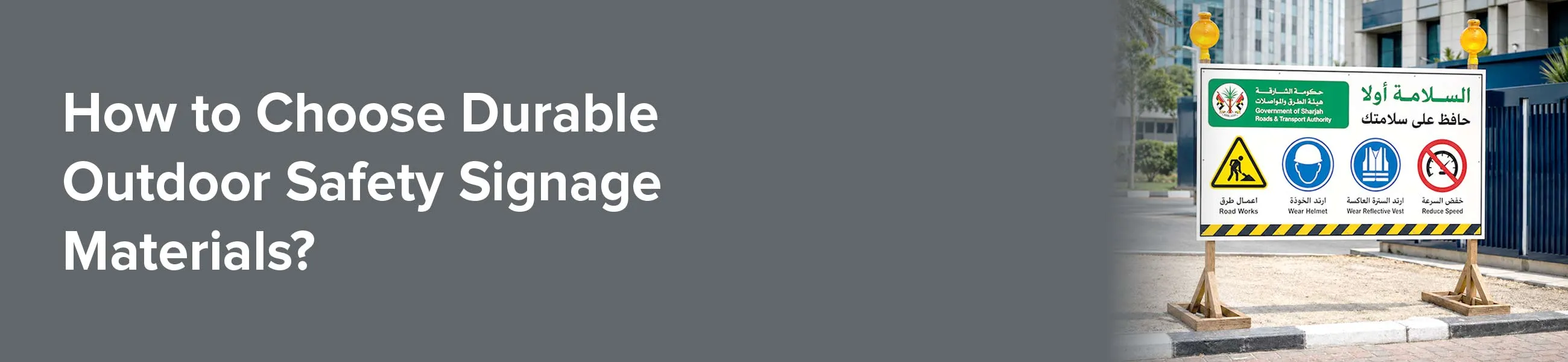
The most durable safety sign materials for outdoor use in Dubai and the UAE are aluminium (1–3 mm), ACP (Aluminium Composite Panel), and stainless steel — each providing UV resistance, structural rigidity, and long-term legibility under the UAE's sustained direct sun, high temperatures, and occasional sandstorm conditions. For indoor environments, rigid PVC, foam board, and self-adhesive vinyl on appropriate substrates are cost-effective and practical. The correct material depends on the installation environment, the sign's expected service life, the regulatory requirements, and whether the sign will be exposed to chemicals, extreme heat, or mechanical abrasion.
This guide covers every major safety signage material used in Dubai, Abu Dhabi, and across the UAE — comparing their properties, durability, applications, and limitations for outdoor, indoor, industrial, hospitality, healthcare, and retail environments.
What Is a Safety Sign Material?
A safety sign material refers to the physical substrate on which a safety sign is produced — the surface that carries the printed or engraved safety message, symbol, and colour coding. The material determines:
- How long the sign remains legible under environmental conditions
- Whether it meets the regulatory standards applicable to the installation environment
- How well it resists UV radiation, temperature cycling, moisture, and mechanical damage
- How it is fixed to the installation surface
- What the sign costs per unit and over its service life
Safety sign materials are distinct from the printing method or the sign content — the same ISO 7010 symbol can be produced on a self-adhesive vinyl sheet, a rigid aluminium panel, a stainless steel plate, or a photoluminescent board, each with fundamentally different performance characteristics under the same environmental conditions.
Why Safety Sign Material Matters in Dubai and the UAE
The UAE's outdoor environment is among the most demanding in the world for signage materials:
- Direct UV intensity — Dubai receives over 3,500 hours of sunlight annually — sustained UV radiation that degrades ink, adhesive, and substrate materials far faster than in temperate climates
- Temperature extremes — Surface temperatures on outdoor sign substrates can exceed 60–70°C in summer — causing delamination, warping, and colour shift in materials not specified for high-temperature use
- Sandstorms and airborne dust — Periodic shamal winds carry fine sand that abrades sign surfaces and clogs fixings over time
- Humidity cycling — Despite being an arid climate, coastal areas of Dubai, Abu Dhabi, and Ras Al Khaimah experience humidity cycling that affects adhesive bonds and can promote corrosion at sign fixings
For indoor environments — corporate offices, hotels, hospitals, and retail shops — the primary concerns are different: chemical resistance to cleaning agents (hospitals), fire rating compliance (all commercial buildings), and aesthetic quality appropriate to the environment (hotels and retail).
Quick summary: Choosing the wrong safety sign material in Dubai and the UAE results in fading, warping, delamination, and illegibility faster than in most other markets — which constitutes both a safety failure (illegible signs do not communicate the hazard) and a compliance failure (damaged signs are cited in safety audits).
Safety Sign Materials — The Complete Guide
1. Aluminium Sheet Safety Signs
What it is: Aluminium sheet safety signs are produced from 0.5 mm to 3 mm thick aluminium alloy panels with UV-printed, screen-printed, or adhesive-applied graphics — typically anodised or powder-coated for additional surface protection.
Key properties:
- Lightweight relative to strength — a 1.5 mm aluminium panel is rigid enough for most safety sign applications while being significantly lighter than steel at equivalent dimensions
- Naturally corrosion-resistant — aluminium does not rust, making it appropriate for outdoor and high-humidity coastal UAE environments without protective coating (though powder-coating or anodising extends surface life further)
- UV-stable — aluminium itself does not degrade under UV, though the printing method and any applied vinyl must also be UV-rated for outdoor use
- Mechanically durable — resists moderate impact, bending, and abrasion better than PVC or foam board alternatives
- Easy to fix — standard screw or rivet mounting; available with pre-drilled corners for standard bracket systems
Best suited for:
- Outdoor construction site safety signs in Dubai and Abu Dhabi
- Road-adjacent and perimeter fence safety signs
- Industrial facility safety signs in exposed positions
- Permanent wayfinding and hazard identification in commercial building exteriors
Typical service life in UAE outdoor conditions: 5–10 years with UV-resistant printing and lamination.
Cost level: Medium — more expensive than PVC, less than stainless steel.
2. ACP (Aluminium Composite Panel) Safety Signs
What it is: ACP is a sandwich panel produced from two thin aluminium face sheets bonded to a polyethylene core — producing a flat, rigid, lightweight panel that is the standard material for large-format outdoor signage across the UAE.
Key properties:
- Exceptional flatness — ACP remains flat across large panel sizes where aluminium sheet may bow or flex; this is particularly important for large-format safety signs read from a distance
- Lightweight at large format — significantly lighter than equivalent-area aluminium sheet at large sign sizes (60 × 90 cm and above)
- High-quality UV printing surface — the aluminium face layers accept direct UV printing with colour accuracy and detail that exceeds most other sign materials
- Weatherproof — the aluminium faces and bonded core are resistant to moisture, temperature cycling, and UV without significant degradation
- Available in standard and fire-retardant cores — FR-grade ACP uses a mineral-filled core that meets UAE commercial building fire rating requirements (important for any safety sign installed in a commercial building in Dubai or Abu Dhabi under DCD — Dubai Civil Defence — standards)
Best suited for:
- Large-format outdoor safety signs on construction hoarding
- Building entrance and perimeter safety signs
- Hospital, hotel, and commercial building safety signage where a flat, premium-quality sign surface is required
- Any safety sign above 30 × 40 cm where panel flatness across the full surface matters
Typical service life in UAE outdoor conditions: 7–15 years with UV-resistant printing.
Cost level: Medium — typically similar to or slightly above aluminium sheet for small formats; more cost-effective than aluminium at large formats due to lower weight.
3. Stainless Steel Safety Signs
What it is: Stainless steel safety signs are produced from 1–3 mm 304 or 316 grade stainless steel — with laser-engraved, UV-printed, or chemically etched graphics. Marine-grade 316 stainless steel is specified for coastal outdoor positions in the UAE where salt air is a factor.
Key properties:
- Maximum durability — the hardest-wearing sign material available for standard safety signage; resists physical impact, abrasion, vandalism, and all standard chemical exposure
- Highest corrosion resistance — 316-grade stainless steel is resistant to salt air, cleaning chemicals, and industrial solvents
- Laser engraving capability — the sign content is permanently marked into the steel surface rather than applied on top — the mark cannot be damaged, faded, or removed without destroying the panel itself
- Very long service life — stainless steel safety signs with laser-engraved or chemically etched content last 15–25+ years in outdoor UAE conditions
- Heavy — significantly heavier than aluminium or ACP at equivalent dimensions; mounting systems must be specified accordingly
- Higher cost — the material cost and production cost of stainless steel signs is the highest in the standard safety sign material range
Best suited for:
- Offshore and marine facility safety signs
- Petrochemical and industrial processing plant safety signs
- High-security facility perimeter signs
- Premium hospitality and institutional permanent safety signs where the sign's visual quality and permanence must match the surrounding environment
- Signs in areas where chemical cleaning, steam cleaning, or pressure washing is routine
Cost level: High.
4. Rigid PVC Safety Signs
What it is: Rigid PVC (polyvinyl chloride) safety signs are produced from 3–5 mm PVC foam board or 1–3 mm solid PVC sheet, with UV-printed or screen-printed graphics and optional lamination.
Key properties:
- Lightweight — the lowest-weight rigid sign material, making PVC signs easy to handle, install, and replace
- Cost-effective — PVC is the most affordable rigid sign material per unit at small and medium formats
- Good indoor durability — in controlled indoor environments (offices, corridors, warehouses, retail), rigid PVC performs well for 3–7 years
- Limited outdoor durability — standard PVC degrades under sustained UV exposure in Dubai: it yellows, becomes brittle, and the surface may crack and warp under repeated thermal cycling
- Chemical sensitivity — PVC is vulnerable to certain solvents and strong cleaning agents; not recommended for chemical plant or hospital environments where aggressive cleaning is routine
Best suited for:
- Indoor safety signs in offices, hotels, hospitals, and retail environments
- Temporary site office safety signs during construction
- Short-duration event safety signage
- Indoor warehouse safety signs not exposed to extreme temperatures or chemical cleaning
Not recommended for: Outdoor positions in Dubai or Abu Dhabi without UV-rated lamination; chemical or industrial processing environments; areas subject to steam or pressure cleaning.
Typical service life in UAE indoor conditions: 3–7 years.
Typical service life in UAE outdoor conditions: 6–18 months without UV lamination; 1–3 years with UV lamination.
Cost level: Low.
5. Self-Adhesive Vinyl Safety Signs
What it is: Self-adhesive vinyl safety signs are produced from pressure-sensitive vinyl film — either calendered (less durable, lower cost) or cast (more durable, higher cost) — with UV-printed graphics and applied directly to a wall, door, floor, equipment, or secondary substrate.
Key properties:
- Maximum flexibility — vinyl can be applied to virtually any smooth surface without requiring a rigid backing panel or mechanical fixings
- Lowest upfront cost — vinyl safety signs have the lowest per-unit material cost of any format
- Calendered vs cast distinction: Calendered vinyl is made by pressing a flat sheet — it is less dimensionally stable and has a shorter outdoor service life. Cast vinyl is produced by flowing liquid material into sheets — it is more dimensionally stable, conforms better to curved surfaces, and lasts significantly longer outdoors
- Outdoor life depends on vinyl grade and ink specification: Standard calendered vinyl with standard inks lasts 6–12 months outdoors in the UAE. Premium cast vinyl with UV-stabilised inks lasts 3–5 years
Best suited for:
- Equipment labelling and machine safety signs
- Temporary safety signs during fit-out or construction phases
- Floor safety markings (with appropriate anti-slip laminate)
- Vehicle and fleet safety signs
- Wall-applied safety signs in indoor commercial environments
Not recommended for: Permanent outdoor installation in Dubai's direct sun without premium cast vinyl and UV-stabilised inks; rough or dusty surfaces where adhesion is compromised.
Cost level: Very low (calendered) to low (cast).
6. Photoluminescent (Glow-in-the-Dark) Safety Signs
What it is: Photoluminescent safety signs use a strontium aluminate or zinc sulphide compound embedded in the sign material — absorbing ambient light and emitting it gradually in darkness. They are used for emergency exit, escape route, and assembly point signs.
Key properties:
- Operates without power — photoluminescent signs provide emergency wayfinding without requiring electrical connection — critical for power failure scenarios in which electrically illuminated emergency signs go dark
- Approved for UAE commercial buildings — photoluminescent emergency exit and escape route signs are approved for use under Dubai Civil Defence (DCD) requirements for commercial buildings when specified and installed correctly
- Requires sufficient ambient light — the sign must be exposed to adequate ambient light (natural or artificial) during normal occupancy to maintain its stored energy for emergency emission
- Not suitable as primary signage — photoluminescent signs are supplementary emergency signs, not primary safety communication signs
Best suited for:
- Emergency exit and escape route signs in Dubai and Abu Dhabi commercial buildings
- Stairwell and corridor emergency lighting where electrical illumination may fail
- Marine and offshore facility emergency signage
- Basement and underground facility emergency egress marking
Cost level: Medium.
7. Acrylic Safety Signs
What it is: Acrylic (PMMA) safety signs use clear, frosted, or coloured acrylic sheet with reverse UV printing, screen printing, or engraved content.
Key properties:
- Premium indoor appearance — acrylic produces a glass-like, premium-quality sign surface suited to hotels, corporate offices, and high-end retail environments
- Good indoor durability — acrylic maintains colour, surface quality, and structural integrity well in air-conditioned interior environments
- UV sensitivity outdoors — standard acrylic yellows under sustained outdoor UV exposure in Dubai and Abu Dhabi; not suitable for permanent outdoor positions
- Scratch susceptibility — acrylic scratches more easily than aluminium or PVC; not appropriate for high-traffic or industrial environments
- Standoff mounting — acrylic signs are typically mounted on chrome or brushed metal standoffs for a premium visual presentation
Best suited for:
- Corporate office health and safety signs (fire exit signs, PPE signs in reception areas)
- Hotel room and corridor safety signs
- Hospital wayfinding and non-clinical safety signs
- Retail environment safety and compliance signs
Not recommended for: Outdoor UAE positions; industrial or construction environments.
Cost level: Medium to high.
Safety Sign Material Comparison Table
| Material | Outdoor UAE Durability | Indoor Durability | Chemical Resistance | UV Resistance | Cost Level | Best For |
|---|---|---|---|---|---|---|
| Aluminium (1.5–3mm) | Excellent (5–10 years) | Excellent | Good | Excellent (with UV ink) | Medium | Outdoor construction, industrial |
| ACP | Excellent (7–15 years) | Excellent | Good | Excellent (with UV ink) | Medium | Large format outdoor, commercial |
| Stainless Steel (304/316) | Outstanding (15–25+ years) | Outstanding | Excellent | Excellent | High | Industrial, marine, premium |
| Rigid PVC | Poor–Moderate (6 months–3 years) | Good (3–7 years) | Moderate | Poor (without UV laminate) | Low | Indoor offices, retail, temp sites |
| Cast Vinyl | Moderate (3–5 years) | Good | Moderate | Good (UV ink) | Low | Equipment labels, floor signs |
| Calendered Vinyl | Poor (6–12 months outdoor) | Moderate | Low | Poor | Very Low | Short-term, temporary signs |
| Photoluminescent | Good (5–10 years indoor) | Good | Moderate | Good (indoor) | Medium | Emergency exit, escape route |
| Acrylic | Poor (outdoors) | Good (3–7 years) | Moderate | Poor (outdoors) | Medium–High | Hotels, offices, premium interiors |
Choosing Safety Sign Material by Environment in Dubai and the UAE
Outdoor Construction Sites
Recommended materials: Aluminium (1.5–2 mm) or ACP with UV-resistant inks and lamination.
Construction sites in Dubai and Abu Dhabi are among the most demanding environments for safety signage — direct sun, temperature extremes, dust, mechanical impact, and regular repositioning as the site evolves. Aluminium and ACP provide the outdoor durability, UV resistance, and physical robustness required for signs that must remain legible across a 12–36 month construction programme.
Corporate Offices and Commercial Buildings
Recommended materials: Rigid PVC, acrylic, or ACP depending on the zone.
Indoor office environments in Dubai's commercial towers are temperature-controlled, low-humidity, and low-impact — making rigid PVC and acrylic both practical choices. For reception and client-facing areas, acrylic with standoff mounting provides the premium appearance appropriate to Dubai's high-standard commercial environment. For functional safety signs in service corridors and back-of-house areas, rigid PVC is cost-effective and adequate.
Hotels and Hospitality
Recommended materials: Acrylic, brushed aluminium, or stainless steel depending on the zone.
Hotel safety signs in Dubai and Abu Dhabi must combine compliance with the visual quality expected in a hospitality environment. Guest-facing areas (corridors, lift lobbies, guest rooms) require acrylic or brushed aluminium signs that harmonise with the interior design. Back-of-house and service areas can use standard rigid PVC or aluminium.
Hospitals and Healthcare Facilities
Recommended materials: ACP or aluminium with chemical-resistant lamination; stainless steel for clinical zones.
Hospital environments in Dubai Healthcare City and Abu Dhabi's healthcare districts require safety signs that withstand daily cleaning with hospital-grade disinfectants. Standard PVC and untreated vinyl degrade under repeated chemical exposure. ACP with chemical-resistant UV lamination or stainless steel are the correct specifications for clinical areas. Photoluminescent signs are required for emergency exit and escape route compliance.
Industrial Facilities and Warehouses
Recommended materials: Aluminium, ACP, or stainless steel (316 grade for chemical environments).
Industrial safety signs in Jebel Ali, KIZAD, and similar UAE industrial zones face a combination of outdoor exposure, chemical vapour, mechanical impact, and vibration. Aluminium and ACP handle standard industrial environments; 316-grade stainless steel is specified where chemical resistance is the primary requirement.
Retail Shops and Shopping Malls
Recommended materials: Rigid PVC, acrylic, or aluminium depending on zone and budget.
Retail safety signs in Dubai Mall, Mall of the Emirates, and similar environments need to be visually appropriate to a high-standard commercial retail context. Acrylic and aluminium both provide the visual quality expected. Rigid PVC is acceptable for service and back-of-house areas. All signs in public-facing retail areas should use non-glare matte finishes to avoid reflective hotspots under strong mall retail lighting.
Ink and Lamination — What Goes on Top of the Material Matters as Much as the Material Itself
The substrate material of a safety sign is only half of the durability equation. The printing method and any lamination applied over the printed surface determine how well the colour and legibility of the sign hold up over time.
UV-Resistant Inks
Safety signs intended for outdoor use in Dubai and the UAE must be printed with UV-stabilised inks — either UV-cured inkjet inks or solvent-based inks with UV inhibitors. Standard dye-based or aqueous inks will fade visibly within weeks under Dubai's direct sunlight.
Anti-UV Lamination
A UV-resistant clear laminate applied over the printed surface provides an additional layer of protection — extending the sign's outdoor service life regardless of the substrate. Matt lamination is recommended for signs read at close to medium range (10 metres and below) to avoid glare under direct sunlight; gloss lamination may be specified for signs read at distance where surface glare is not a viewing concern.
Expert Tips for Specifying Safety Sign Materials in Dubai and the UAE
- Always specify UV-resistant inks and lamination for outdoor signs. The substrate material alone does not determine outdoor durability — an aluminium panel with standard indoor inks will fade just as quickly as a PVC panel under Dubai's direct sun. UV-rated inks and lamination are non-negotiable for outdoor UAE sign specifications.
- Use FR (fire-retardant) grade ACP for all safety signs in commercial buildings. Dubai Civil Defence (DCD) requirements for commercial buildings specify fire-retardant materials for wall and ceiling-mounted elements. Standard ACP with polyethylene core does not meet FR standards — always specify FR-grade ACP with a mineral-filled core for signs in commercial building interiors.
- Specify 316-grade stainless steel for coastal outdoor positions. Buildings in Dubai Marina, JBR, Palm Jumeirah, and Abu Dhabi's waterfront are exposed to salt-laden air that accelerates corrosion at sign fixings and edges. Standard 304 stainless steel or aluminium fixings will corrode faster than expected in these positions.
- Do not use standard calendered vinyl for outdoor UAE safety signs. Calendered vinyl applied outdoors in Dubai will begin to crack and lift within 12 months. If vinyl must be used for outdoor positions, specify premium cast vinyl with UV-stabilised inks and a UV-resistant clear laminate overlay.
- Plan for replacement frequency in the sign budget. In high-UV outdoor positions in Dubai, even premium outdoor sign materials will require replacement eventually. Planning the replacement cycle — and budgeting the replacement cost — avoids compliance failures that occur when faded signs are not replaced because budget was not allocated.
Where to Source Safety Sign Materials and Printing in Dubai and the UAE
For safety officers, facilities managers, HSE consultants, and procurement teams sourcing safety signs in Dubai, Abu Dhabi, and across the UAE, Deluxe Printing produces safety signage across the full material range — aluminium, ACP (standard and FR-grade), rigid PVC, stainless steel, photoluminescent, acrylic, and vinyl — with UV-resistant printing, chemical-resistant lamination, and bilingual English and Arabic text for all sign categories. With over 25 years of commercial and industrial signage production in Dubai, the Deluxe team advises on material specification for specific environments, regulatory compliance requirements, and service-life expectations.
Key Takeaways
- The best outdoor safety sign materials for Dubai and the UAE are aluminium (1.5–3 mm), ACP, and stainless steel — each providing UV resistance, structural rigidity, and long-term legibility under UAE outdoor conditions
- UV-resistant inks and lamination are as important as the substrate — an aluminium panel with standard indoor inks will fade as quickly as PVC under Dubai's direct sun
- Rigid PVC is appropriate for indoor use only in Dubai's climate — it yellows, warps, and becomes brittle under sustained outdoor UV without a UV laminate, and even with lamination its outdoor life is limited
- FR-grade ACP (fire-retardant) must be specified for safety signs installed in commercial buildings in Dubai under DCD (Dubai Civil Defence) requirements
- 316-grade stainless steel is required for coastal outdoor positions and chemical processing environments where standard aluminium or 304 stainless would corrode faster than acceptable
- Photoluminescent materials are approved by Dubai Civil Defence for emergency exit and escape route signs in commercial buildings — they provide emergency wayfinding without electrical power
- Replacement frequency planning is essential — even premium outdoor sign materials require eventual replacement, and budget must be allocated before compliance failures occur
Frequently Asked Questions
Contact Deluxe Printing
- Al Qusais Industrial Area 2 is located in Dubai, UAE
- Call us on +971 4272 5202
- Email: print@dlxprint.com