What are the Best Materials for Durable Desk Name Plates?
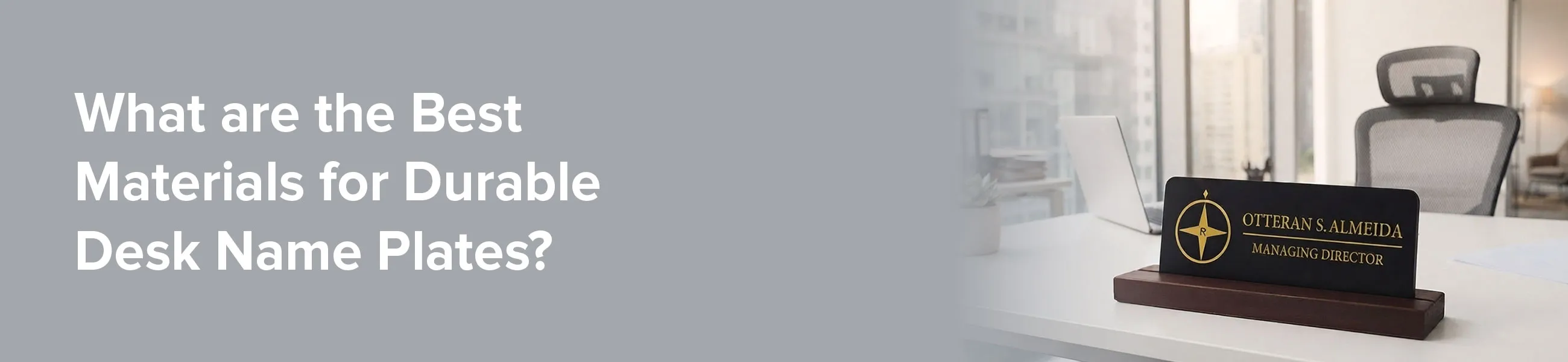
The best materials for desk name plates in Dubai and UAE offices are acrylic (clear, frosted, or coloured), brushed aluminium, and ABS plastic — each offering a different combination of visual quality, durability, and cost suitable for different office environments and corporate standards. Acrylic is the most widely used material for desk nameplates in Dubai's commercial offices — it provides a premium, glass-like appearance, accepts printed and engraved text precisely, and performs well in air-conditioned indoor environments for 3–7 years. Brushed aluminium suits executive desk positions. ABS plastic suits high-volume, budget-conscious procurement. Wood and bamboo suit design-led or sustainability-focused environments.
This guide covers every major material for desk name plates used in offices and commercial buildings across Dubai, Abu Dhabi, and the UAE — comparing properties, durability, branding options, and best-fit applications for different corporate environments.
What Is a Desk Name Plate?
A desk name plate — also called a desk nameplate, desk sign, or desk identifier — is a custom-printed or engraved display panel positioned on or at the front edge of a desk or workstation to identify the person occupying that position by name, title, and optionally department.
In UAE corporate offices, desk name plates serve three functions:
- Navigation — enabling visitors, colleagues, and new staff to identify who sits where without needing to ask
- Professionalism — communicating that the organisation maintains an organised, professionally presented workspace
- Brand consistency — when produced in consistent materials, finishes, and typography across the full office, desk name plates contribute to the visual coherence of the workspace
Desk name plates differ from door name plates (which are mounted at eye height on a door or partition) and wall name plates (which are surface-mounted on a wall or column). Desk name plates are either freestanding in a holder on the desk surface or affixed to the front face of the desk panel.
Why Material Selection Matters for Desk Name Plates in Dubai
Corporate offices across Dubai's commercial districts — Business Bay, DIFC, Sheikh Zayed Road, JLT, and Abu Dhabi's Central Business District — maintain consistently high interior design standards. A desk name plate in a premium office environment must be visually proportionate to its surroundings — a cheap plastic name plate beside premium furniture communicates the wrong message about the organisation.
Beyond aesthetics, desk name plate material selection determines:
- How well the text and logo reproduce — some materials accept high-definition printing; others are limited to single-colour engraving
- How long the plate remains presentable — a material that yellows under office lighting or scratches with regular handling will require replacement within 12–18 months
- How quickly replacements can be ordered — for offices with regular staff movement, the reorder process for individual replacement name plates matters as much as the initial order quality
Quick summary: Material selection for desk name plates in Dubai is a balance of visual quality, durability in an air-conditioned indoor environment, compatibility with the office's interior design standard, and procurement practicality for ongoing replacement needs.
The Main Materials for Desk Name Plates
1. Acrylic Desk Name Plates
What it is: Acrylic (PMMA — polymethyl methacrylate) is a transparent or coloured thermoplastic available in clear, frosted, white, black, and custom colour-tinted sheets. It is the most widely used material for desk name plates across corporate offices in Dubai.
Key properties:
- Optical clarity — clear acrylic panels allow reverse-printed text to appear with a depth and precision that flat surface printing on opaque materials cannot replicate
- Surface options — available in gloss clear, frosted, and solid-colour finishes, each producing a distinct visual aesthetic
- Dimensional stability — in air-conditioned office environments at 20–24°C, acrylic maintains its shape and does not warp, bow, or discolour
- Lightweight — acrylic is significantly lighter than metal at equivalent thicknesses, making it practical for desk holder display without the holder tipping under the plate's weight
Clear Acrylic (Reverse Printed)
The most premium standard acrylic desk name plate specification — UV-printed text and graphics on the back face of a clear acrylic panel, viewed through the material from the front. The print is protected by the full acrylic thickness, making it resistant to scratching, abrasion, and handling damage during normal office use.
The reverse-printed clear acrylic desk name plate is the most requested format for corporate offices in DIFC, Business Bay, and Sheikh Zayed Road — it reads as genuinely premium without the cost of metal or engraved stone alternatives.
Standard thickness: 3 mm for small formats (15 × 5 cm); 5 mm for wider formats (25 × 7 cm) where panel rigidity is needed.
Frosted Acrylic
Frosted acrylic is translucent rather than transparent — it diffuses light through the panel surface, giving it a soft, matte appearance that is visually distinctive from standard clear acrylic. Text is typically surface-printed or laser-engraved directly onto the frosted face.
Frosted acrylic desk name plates are popular in design-led office environments — co-working spaces, architecture and design studios, media companies, and any office where the standard clear-and-chrome acrylic aesthetic feels too conventional for the brand.
Coloured Acrylic
Solid-colour acrylic sheets — black, navy, forest green, dark grey, or any custom RAL-matched colour — allow the desk name plate to be produced in the office's specific brand palette. Text is applied via laser engraving (revealing the natural acrylic colour beneath the surface tint) or surface UV printing (for full-colour logo and text).
Durability in UAE indoor conditions: 3–7 years in standard air-conditioned office positions. Acrylic is not recommended for positions exposed to direct sunlight — it can yellow over time under sustained UV, though this is rarely a concern for desk positions in air-conditioned interiors.
Cost level: Low to medium.
2. Brushed Aluminium Desk Name Plates
What it is: Brushed aluminium desk name plates are produced from aluminium alloy sheet with a directional satin brush finish — a linear texture applied to the surface that gives the material its characteristic warm, reflective-but-not-mirror appearance.
Key properties:
- Executive quality feel — the weight and finish of brushed aluminium communicates quality at a level that acrylic and plastic cannot match; it is the go-to material for senior executive and director-level desk positions in Dubai's corporate sector
- Laser engraving produces exceptional results — laser marking on brushed aluminium creates a precise, permanent contrast mark that is immediately visible against the directional brushed surface
- Anodised colour options — brushed aluminium is available in natural silver, anodised gold, anodised black, and anodised bronze finishes, allowing the plate to match the desk or office hardware specification
- Corrosion-resistant — aluminium does not rust in normal indoor office conditions; no maintenance coating is required
Branding methods for brushed aluminium:
- Laser engraving — the most common and most effective method; produces a permanent, precise mark that does not scratch, fade, or peel
- UV printing — full-colour logo and text applied to the aluminium surface for accurate brand colour reproduction
- Pad printing — cost-effective for single-colour text on large-volume orders
Durability in UAE indoor conditions: 10+ years in standard office use — the most durable desk name plate material available for interior positions.
Cost level: Medium to high — higher unit cost than acrylic but justified for executive and client-facing positions.
3. ABS Plastic Desk Name Plates
What it is: ABS (Acrylonitrile Butadiene Styrene) is an engineering-grade thermoplastic — stronger and more impact-resistant than standard PVC but less visually premium than acrylic. ABS desk name plates are typically injection-moulded or sheet-cut and printed.
Key properties:
- Impact resistant — more resistant to cracking from accidental desk contact than acrylic or glass alternatives
- Cost-effective at volume — ABS is the lowest-cost rigid material for desk name plates at large procurement quantities
- Good surface for printing — ABS accepts direct printing, pad printing, and engraving with adequate result quality
- Available in a range of standard colours — white, black, and grey are the most common stock colours for ABS name plate blanks
Limitations:
- Visual quality is noticeably lower than acrylic — ABS does not produce the optical depth and glass-like clarity of clear acrylic
- Not suitable for executive or client-facing positions where material quality is part of the impression
- Can show surface scratches and wear faster than aluminium under active handling
Durability in UAE indoor conditions: 3–5 years under normal desk use.
Cost level: Low — the most budget-effective option for high-volume office procurement.
Best suited for: Open-plan offices with high staff turnover, co-working environments, schools and educational institutions, and any context in Dubai where desk name plate budgets are limited and replacement frequency is high.
4. Stainless Steel Desk Name Plates
What it is: Stainless steel desk name plates use 304-grade stainless steel sheet with a brushed, mirror-polished, or satin finish — the most premium and most durable desk name plate material available.
Key properties:
- Maximum durability — stainless steel desk name plates last indefinitely in normal indoor office use; they do not scratch visibly under desk handling, do not yellow, warp, or degrade
- Mirror or brushed finish options — mirror-polished stainless reflects surrounding light and creates a high-luxury aesthetic; brushed stainless has the same directional texture as brushed aluminium but with higher density and lustre
- Laser engraving and chemical etching — both produce permanent, precise marks on the steel surface; chemically etched text has greater depth than laser marks and a more tactile quality
- Heavier than acrylic or aluminium — a 2 mm stainless steel plate is noticeably heavier than the equivalent acrylic or aluminium; desk holders must be specified accordingly
Best suited for: Board-level, C-suite, and director offices in Dubai's financial, legal, and government sectors — environments where the desk name plate's material communicates the same institutional permanence as the role it identifies.
Cost level: High — the most expensive material in the standard desk name plate range.
5. Wood and Bamboo Desk Name Plates
What it is: Wooden desk name plates are produced from solid timber (teak, walnut, oak), MDF (medium-density fibreboard), or bamboo — typically with laser-engraved text and a protective clear varnish or oil finish.
Key properties:
- Natural texture and warmth — the wood grain adds visual and tactile depth that no synthetic material can replicate; each plate is subtly unique due to natural grain variation
- Laser engraving on wood produces high-contrast, tactile marks — the laser burns the text into the wood surface, creating a recessed, permanently visible mark that deepens with the natural wood ageing process
- Bamboo is the eco-friendly option — for offices with sustainability commitments or ESG programmes, bamboo desk name plates communicate environmental awareness through the material itself
- More susceptible to moisture and humidity variation — solid wood desk name plates in offices with very dry or very humid conditions can expand and contract slightly over time; this is rarely a significant issue in Dubai's temperature-controlled offices but should be considered
Best suited for: Design studios, creative agencies, boutique consultancies, wellness and hospitality businesses, eco-conscious organisations, and any office environment in Dubai or Abu Dhabi where natural materials are part of the interior design language.
Cost level: Medium to high for premium timber; medium for MDF with timber-effect finish; comparable to premium acrylic for bamboo.
Desk Name Plate Material Comparison Table
| Material | Visual Quality | Durability (Indoor) | Engraving | Full-Colour Print | Cost Level | Best For |
|---|---|---|---|---|---|---|
| Clear acrylic (reverse print) | High | 3–7 years | Limited | Excellent | Low–Medium | Standard corporate offices |
| Frosted acrylic | Medium–High | 3–7 years | Good | Good | Low–Medium | Design-led offices, co-working |
| Coloured acrylic | Medium–High | 3–7 years | Excellent | Good | Low–Medium | Brand-colour matched offices |
| Brushed aluminium | High | 10+ years | Excellent | Good | Medium–High | Executive desks, senior roles |
| ABS plastic | Medium | 3–5 years | Moderate | Good | Low | High-volume, schools, co-working |
| Stainless steel | Very High | Indefinite | Excellent | Limited | High | C-suite, board, government |
| Wood/teak/walnut | High (natural) | 5–10 years | Excellent | Limited | Medium–High | Creative, eco, boutique |
| Bamboo | Medium–High | 5–8 years | Excellent | Limited | Medium | Sustainability-focused offices |
| MDF (timber-effect) | Medium | 3–5 years | Good | Good | Low–Medium | Budget wood aesthetic |
Desk Name Plate Materials by Office Environment in Dubai
Corporate Tower Offices (DIFC, Business Bay, Sheikh Zayed Road)
Recommended material: Clear acrylic (3–5 mm, reverse UV printed) or brushed aluminium
These environments maintain premium interior standards. Clear acrylic with reverse UV printing produces a name plate that reads as premium, is visually consistent across large multi-floor installations, and can be reordered cost-effectively when staff change. Brushed aluminium is the upgrade for director and senior partner positions where material weight and finish communicate the level of seniority.
Government and Institutional Offices (Abu Dhabi, Dubai Government Entities)
Recommended material: Brushed aluminium with laser engraving or stainless steel
Government offices in Abu Dhabi and Dubai typically use brushed aluminium or stainless steel desk name plates — materials that communicate institutional permanence and are consistent with the formal interior design standard of government facilities. Bilingual English and Arabic text is standard for government desk name plates across the UAE.
Co-Working and Flexible Workspace (Dubai Internet City, in5, Hub71)
Recommended material: Frosted acrylic or ABS plastic with slide-in name insert system
Co-working environments have high occupant turnover — hot-desking and flexible membership mean desk occupants change frequently. A slide-in name insert system (where the holder is fixed and only the printed insert changes) dramatically reduces replacement cost and production time for these environments.
Healthcare and Hospital Administration (Dubai Healthcare City, Abu Dhabi)
Recommended material: Brushed aluminium or stainless steel for clinical administration; acrylic for non-clinical office areas
Healthcare environments require desk name plates that withstand regular cleaning with disinfectant products. Brushed aluminium and stainless steel withstand chemical cleaning better than acrylic or ABS, which may discolour or crack under repeated exposure to hospital-grade cleaning agents in clinical administration areas.
Design Studios, Creative Agencies, Architecture Firms
Recommended material: Walnut, teak, or bamboo with laser engraving
Creative and design-industry offices in Dubai — including architecture firms in DIFC and design studios in Alserkal Avenue — often use natural material desk name plates as part of a workspace that intentionally incorporates texture, craft, and material quality into the environment. Laser-engraved walnut or teak desk name plates are visually distinctive, immediately communicate design awareness, and are consistent with the natural material palette common in creative office interiors.
Branding Methods for Desk Name Plates — Which Works With Which Material
The branding method applied to a desk name plate determines how well the text, logo, and design reproduce — and different materials are compatible with different branding techniques.
| Branding Method | Best Materials | Result Quality | Notes |
|---|---|---|---|
| Reverse UV printing | Clear acrylic | Very high — protected print depth | Standard for corporate acrylic |
| Surface UV printing | Acrylic, aluminium, ABS, steel | High — full colour | Surface exposed to handling |
| Laser engraving | Aluminium, wood, bamboo, acrylic | Very high — permanent | Best for logos and clean text |
| Laser marking (metal) | Stainless steel, aluminium | Very high — permanent contrast | No material removal — colour change |
| Pad printing | ABS, PVC, acrylic | Good — single colour | Suited to volume, simple logos |
| Typeset name insert | Any holder system | Variable (depends on print) | Cost-effective for high-turnover |
Best Practices for Desk Name Plate Material Selection in Dubai
- Standardise material across the full office — mixing acrylic on some desks and aluminium on others, or using different holder colours across floors, creates visual inconsistency that communicates poor facilities management. Establish one standard material, finish, and holder type for each staff category and apply it consistently building-wide.
- Choose reverse-printed clear acrylic for standard corporate positions and laser-engraved brushed aluminium for senior positions. This two-tier approach is standard in many Dubai corporate offices — it communicates seniority through the material without requiring premium materials at every desk.
- Specify bilingual English and Arabic for client-facing and public-facing desk positions. In Dubai and Abu Dhabi's mixed-language office environments, bilingual desk name plates — particularly at reception and front-desk positions — ensure the plate is immediately comprehensible to the full range of visitors and colleagues the occupant interacts with.
- Plan for individual name plate replacement, not only initial orders. Staff movement is a normal feature of Dubai's dynamic business environment — the most practical desk name plate system is one where an individual replacement plate can be ordered quickly and at low cost, matching exactly the original specification. This is easier when you work with one supplier throughout.
- For high-turnover or hot-desk environments, invest in quality holders with slide-in insert systems rather than permanently fixed name plates — the holder quality is what visitors see from a distance, and the insert is the only component that needs replacing when an occupant changes.
Where to Order Desk Name Plates in Dubai and the UAE
For facilities managers, procurement teams, and office administrators sourcing desk name plates across Dubai, Abu Dhabi, and the UAE, Deluxe Printing produces desk name plates in acrylic, brushed aluminium, ABS, stainless steel, wood, and bamboo — with UV printing, laser engraving, and bilingual English and Arabic text options, and a full range of holder and mounting hardware. With over 25 years of commercial signage and name plate production in Dubai, the Deluxe team advises on material specification, branding method, and holder compatibility for bulk corporate orders across any office size, from a single executive replacement to a multi-floor building-wide installation.
Key Takeaways
- The most widely used materials for desk name plates in Dubai and UAE offices are clear acrylic (reverse UV printed), brushed aluminium, and ABS plastic — each suited to different office environments and budget levels
- Clear acrylic is the standard corporate desk name plate material — it provides premium optical quality, reverse-print protection, and 3–7 year durability in air-conditioned offices at a cost-effective price for large installations
- Brushed aluminium is the preferred material for executive and senior positions — laser-engraved marks are permanent and precise, and the material communicates institutional quality appropriate to leadership roles
- ABS plastic is the most budget-effective choice for high-volume procurement in co-working, educational, and high-turnover environments where replacement frequency is high and cost-per-unit is the primary consideration
- Stainless steel is the most durable material available — appropriate for C-suite, board-level, and government positions where the name plate is expected to remain in service indefinitely
- Wood and bamboo suit design-led, creative, and eco-focused offices where natural material texture is part of the workspace's design language
- Bilingual English and Arabic text should be specified for client-facing and public-facing desk positions across Dubai and Abu Dhabi office environments
- Standardising material and finish across the full office produces a more professional visual result than mixing materials — and simplifies the ongoing replacement procurement process
Frequently Asked Questions
Contact Deluxe Printing
- Al Qusais Industrial Area 2 is located in Dubai, UAE
- Call us on +971 4272 5202
- Email: print@dlxprint.com