What are the Best Materials for Durable Building Flags in Harsh Weather Conditions?
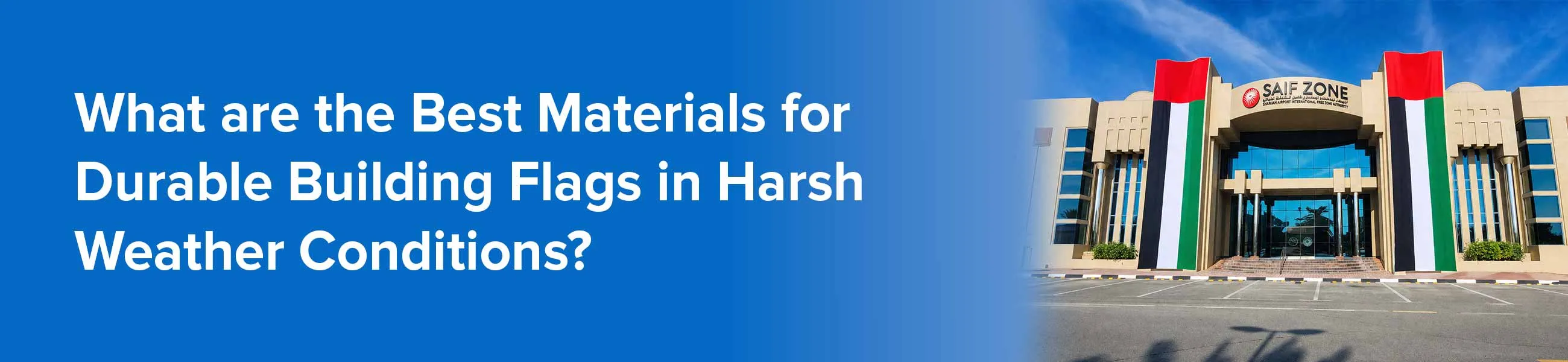
The best materials for building flags in harsh weather conditions are knitted polyester, woven polyester, and nylon — each offering different balances of durability, color vibrancy, wind resistance, and UV stability for outdoor flagpole installations. In Dubai and across the UAE, where building flags on commercial towers, corporate buildings, hotels, government facilities, and shopping complexes face sustained UV radiation, extreme heat, coastal humidity, and high winds — material selection is the single most important factor in determining how long a building flag maintains its visual quality and structural integrity after installation.
What Are Building Flags?
Building flags are large-format fabric flags mounted on permanent or semi-permanent flagpoles fixed to the exterior of buildings — including commercial towers, corporate headquarters, hotels, government buildings, shopping complexes, residential compounds, and private homes. They display national flags, corporate branding, event signage, promotional messaging, or decorative visual identity in a format that is visible from significant distances across urban and suburban environments.
In Dubai and Abu Dhabi, building flags are a prominent feature of the commercial and civic landscape — displayed on flagpoles at building entrances, rooftop installations, car park structures, property boundary walls, and along the approach roads of major developments. The UAE's active culture of national pride, corporate branding standards, and hospitality presentation drives consistent demand for high-quality building flags across every property sector in the country.
Unlike smaller handheld or promotional flags, building flags are structural outdoor displays — exposed to weather conditions continuously across months or years of installation. The material used to produce a building flag determines how it performs under those conditions and how long it continues to represent the brand or identity it displays at the professional standard a prominent outdoor installation requires.
Why Material Selection Matters for Building Flags in the UAE
The UAE presents a combination of environmental conditions that are among the most demanding for outdoor flag materials anywhere in the world.
Extreme UV radiation. Dubai and Abu Dhabi receive intense solar UV exposure year-round. Building flag materials without strong UV-resistant properties and UV-stable dyes fade noticeably within weeks of outdoor installation — particularly damaging for corporate and government building flags where consistent color accuracy is a brand and compliance requirement.
Sustained high temperatures. Summer temperatures across the UAE regularly exceed 45°C in direct sun. Certain flag fabrics — particularly those with lower denier ratings or inadequate heat-stable dye processes — become brittle, lose tensile strength, or show accelerated color degradation under sustained extreme heat conditions.
Coastal humidity and salt air. Dubai Marina, Palm Jumeirah, Abu Dhabi Corniche, Yas Island, and hundreds of other coastal commercial and residential developments across the UAE expose building flags to salt-laden air that accelerates thread degradation and dye fading on fabrics without adequate protective finishing.
High winds and wind cycling. The UAE experiences consistent coastal breezes, channeled urban wind effects between tall buildings in Downtown Dubai and Business Bay, and periodic Shamal wind events — all of which create repeated mechanical stress on building flag fabrics through constant flexing, snapping, and flapping. Flag materials without adequate tensile strength and tear resistance fail at seams, hems, and attachment points under this repeated mechanical loading.
Sand and dust. Periodic sandstorms across the UAE create abrasive conditions that physically wear the surface of flag fabrics over time — accelerating the degradation of print surfaces and protective coatings on materials without adequate abrasion resistance.
The Best Materials for Building Flags in the UAE
1. Knitted Polyester — The Standard for Outdoor Building Flags
Knitted polyester is the most widely used and recommended material for outdoor building flags across Dubai and the UAE. It is produced by knitting polyester yarn into an interlocked loop structure — creating a fabric that combines high tensile strength with significant flexibility and excellent wind performance.
What makes knitted polyester the standard:
The knitted loop structure of the fabric allows it to stretch and flex under wind load without the weave distortion or thread breakage that affects woven alternatives under the same mechanical stress. This flexibility is the fundamental property that makes knitted polyester the dominant flag fabric for building flag applications worldwide — and particularly relevant in the UAE's high-wind coastal and urban environments.
Key properties:
- High tensile strength in both warp and weft directions
- Excellent flexibility under repeated wind cycling — reduces mechanical fatigue at seams and attachment points
- Superior UV resistance when produced with UV-stable dispersion-dyed yarns
- Colorfastness across repeated exposure to UV radiation, salt air, and high temperatures
- Available in 110GSM to 150GSM weights for standard outdoor building flag applications
- Accepts dye-sublimation printing for full-color, edge-to-edge design reproduction
- Lightweight — reduces wind loading on flagpole structures compared to heavier woven alternatives
Best for: Corporate building flags on commercial towers, hotel entrance flagpoles, shopping complex perimeter flags, residential compound entrance flags, and any outdoor building flag application requiring extended durability across UAE weather conditions.
Expert Tip: For building flags installed in coastal positions across Dubai Marina, Palm Jumeirah, JBR, or the Abu Dhabi Corniche — specify knitted polyester produced with solution-dyed or dispersion-dyed yarns rather than reactive-dyed alternatives. Solution-dyed polyester locks color into the fiber during yarn production rather than applying dye to the surface afterward — producing significantly superior colorfastness under the combined UV and salt-air exposure conditions of UAE coastal environments.
2. Woven Polyester — Premium Weight and Visual Presence
Woven polyester flag fabric is produced by interlacing polyester yarns in a traditional over-under weave pattern — creating a heavier, stiffer fabric with a smoother, more structured surface than knitted alternatives.
Key properties:
- Higher GSM than knitted polyester — typically 115GSM to 160GSM for standard building flag applications
- Smoother surface texture — produces sharper print detail on dye-sublimation printed flags
- More structured drape — holds its shape more firmly in light wind conditions than lighter knitted fabrics
- Less flexible than knitted polyester under heavy wind cycling — more susceptible to seam stress in sustained high-wind positions
- Excellent UV resistance when produced with high-quality dispersion-dyed yarns
- Available in single-sided and double-sided (back-to-back stitched) configurations
Why it works in the UAE: Woven polyester is the preferred specification for building flags where visual presentation quality and print sharpness are the primary requirements — flagship hotel entrances, government building installations, corporate headquarters, and prestigious residential developments where the flag is viewed up close and the print detail needs to read at a premium quality level.
Limitation in high-wind positions: The stiffer woven structure makes this fabric more susceptible to seam stress and edge fraying under sustained heavy wind cycling than knitted polyester. For building flag positions with consistent high wind exposure — rooftop installations, elevated flagpoles on tall commercial towers, and coastal perimeter positions — knitted polyester is the more structurally resilient specification despite the slightly lower print surface smoothness.
3. Nylon — Lightweight Performance for High-Wind Environments
Nylon flag fabric is a synthetic material produced from polyamide fibers — valued for its exceptional strength-to-weight ratio, rapid drying properties, and outstanding wind performance in high-wind outdoor environments.
Key properties:
- The lightest standard flag fabric available — maximum response to minimal wind movement
- Exceptionally strong relative to its weight — high resistance to tearing under wind stress
- Rapid drying — does not retain moisture after rain or high-humidity exposure
- Slightly less UV-resistant than polyester — requires UV-stabilized dye processes for outdoor UAE applications
- Accepts direct screen printing and dye processes — less commonly produced with full-color dye-sublimation than polyester alternatives
- Natural lustrous sheen — produces a more vibrant, luminous appearance in sunlight than matte polyester alternatives
Why it works in the UAE: Nylon is the standard specification for national flag production across many international flag manufacturing standards — its strength, lightweight wind performance, and characteristic luminous appearance in sunlight make it the preferred material for ceremonial and official national flag displays on government buildings, diplomatic missions, and official event venues across Dubai and Abu Dhabi.
Limitation: Nylon is marginally less UV-resistant than polyester under sustained outdoor conditions — making it a slightly higher-maintenance specification for permanent commercial building flag installations expected to remain in position for 12 months or more without replacement. For government and ceremonial applications where accurate color representation is the priority and regular flag replacement is part of the maintenance protocol, this limitation is manageable. For commercial building flags expected to last 18–24 months or more, knitted polyester with UV-stable dyes is the more durable long-term specification.
4. Mesh Fabric — Wind-Resistant for Exposed Positions
Mesh flag fabric is a semi-open weave or knit construction — similar to mesh vinyl used in banner production — that allows air to pass through the fabric surface rather than catching against it. It is used for building flag applications in extremely high-wind positions where solid fabric flags create excessive structural load on flagpoles and fixings.
Key properties:
- Open mesh construction significantly reduces wind loading on flagpoles and mounting hardware
- UV-resistant synthetic fiber composition
- Reduced color density compared to solid fabric — the open mesh structure reduces the total ink coverage per unit area
- Less visually impactful than solid fabric at distance — the mesh construction slightly reduces apparent color saturation and print sharpness from a viewing distance
Best for: Rooftop flagpole installations on tall commercial towers in wind-exposed positions, outdoor perimeter flag lines in open coastal or desert locations, and any building flag application where wind loading on the flagpole structure is a structural engineering consideration.
5. Canvas — For Decorative and Short-Term Applications
Canvas flag fabric — typically a cotton or cotton-polyester blend — is a heavier, more rigid material historically used for traditional flag production before synthetic alternatives became available. It is occasionally used for decorative building flag applications, boutique hotel branding, and heritage-style flagpole displays where the textured fabric aesthetic is part of the visual design intent.
Limitation for UAE outdoor use: Canvas absorbs moisture, dries slowly, and degrades faster than synthetic alternatives under the combined UV, heat, and humidity conditions of the UAE's outdoor environment. It is not recommended as a primary material for permanent building flag installations in Dubai or Abu Dhabi — knitted polyester or nylon will significantly outlast canvas in the same outdoor position under UAE conditions.
Building Flag Materials Comparison Table
| Material | UV Resistance | Wind Performance | Print Quality | Durability (UAE) | Best For | Cost Level |
|---|---|---|---|---|---|---|
| Knitted Polyester | Excellent | Excellent | Very Good | 12–24 months+ | All outdoor building flags | Mid |
| Woven Polyester | Excellent | Good | Excellent | 12–18 months | Prestige installations, close viewing | Mid |
| Nylon | Good–Very Good | Excellent | Good | 12–18 months | Government, ceremonial, national flags | Mid |
| Mesh Fabric | Good | Excellent | Moderate | 12–18 months | High-wind rooftop, exposed positions | Mid |
| Canvas | Moderate | Poor | Good | 6–12 months | Decorative, short-term, boutique | Budget |
How Building Flags Are Printed — Methods and Their Impact on Outdoor Durability
Dye-Sublimation Printing
The most widely used printing method for outdoor building flags across Dubai and the UAE. Sublimation dye is heat-transferred into the polyester fiber structure — bonding permanently with the fabric rather than sitting on the surface.
Why it matters for UAE outdoor durability: Because the dye is embedded within the fiber rather than applied as a surface coating, sublimation-printed building flags are significantly more resistant to UV fading, abrasion, and moisture degradation than surface-printed alternatives. The color is in the fabric — not on top of it — and cannot be washed, worn, or exposed off the surface in the same way as screen or digitally printed surface inks.
Limitation: Dye-sublimation works only on polyester substrates. It cannot be used on nylon or canvas flag materials — these require alternative printing processes.
Screen Printing
A traditional flag printing process where ink is applied through a mesh screen directly onto the fabric surface. Used for nylon flags and for applications requiring Pantone-accurate spot color reproduction — particularly important for official national flags and corporate flags where precise brand color matching is a specification requirement.
Outdoor durability consideration: Screen-printed inks sit on the fabric surface rather than within the fiber — making them more susceptible to surface abrasion and UV degradation than sublimation-printed polyester flags over extended outdoor exposure in UAE conditions. High-quality UV-resistant screen printing inks mitigate this significantly for standard outdoor building flag lifespans.
Digital Direct Printing
Direct digital printing applies ink onto the fabric surface using large-format inkjet technology with UV-curable or reactive inks. Less commonly used for outdoor building flags than dye-sublimation — surface-applied digital inks require UV-resistant formulations and protective coatings to achieve comparable outdoor durability to sublimation-printed polyester.
Building Flag Specifications for Different Property Types in the UAE
Commercial Towers and Corporate Buildings
Recommended specification: Knitted polyester 120–140GSM, dye-sublimation printed, double-sided (back-to-back stitched or double-layer construction), reinforced header with brass grommets or rope-and-toggle attachment, triple-stitched fly hem.
Corporate building flags on commercial towers in Downtown Dubai, Business Bay, DIFC, and Jumeirah Lake Towers are viewed from significant distances across the urban landscape — ensuring that logo colors and corporate identity are reproduced with sublimation-quality accuracy and maintained across the extended outdoor exposure periods typical of permanent commercial flagpole installations.
Hotels and Hospitality Properties
Recommended specification: Woven polyester 130–150GSM for close-viewing entrance flagpole installations, knitted polyester for elevated or rooftop positions. Dye-sublimation printing with Pantone-referenced color proofing for brand color accuracy across multi-flag installations.
Hotel entrance flagpoles across Dubai's luxury hotel corridor — including properties in Jumeirah Beach Road, Palm Jumeirah, Dubai Marina, and Downtown Dubai — display corporate branding flags in close proximity to arriving guests. The premium visual standard of these installations requires print quality and color accuracy that woven polyester with dye-sublimation printing delivers more effectively than lighter knitted alternatives at standard entrance flagpole heights.
Government Buildings and Official Installations
Recommended specification: Nylon for UAE national flag displays, following official flag specification standards. Knitted polyester for departmental and organizational branding flags. All specifications should conform to UAE Federal Flag Law requirements for national flag display.
Building flags on government facilities across Dubai, Abu Dhabi, and other UAE emirates are subject to specific regulatory requirements governing the display of the UAE national flag — including correct proportions, color accuracy, and respectful installation standards. All national flag specifications for government building installations should conform to the applicable UAE federal legislation governing flag display.
Shopping Complexes and Retail Developments
Recommended specification: Knitted polyester 110–130GSM for perimeter and entrance flagpole lines, dye-sublimation printed with seasonal or promotional design capability. Lightweight specification reduces wind loading across multi-flag perimeter installations and allows faster and more cost-effective graphic changes for seasonal promotional campaigns.
Shopping complexes across Dubai and Abu Dhabi — including large mall developments, retail strips, and mixed-use commercial complexes — use building flag lines along perimeter approaches and entrance areas for promotional campaigns, seasonal branding, and tenant identification. The ability to update flag graphics cost-effectively for seasonal promotions makes lightweight knitted polyester with dye-sublimation printing the practical standard for retail property flag programs.
Residential Compounds and Private Homes
Recommended specification: Knitted polyester 110–120GSM for entrance flagpole installations at residential compound gatehouses, standard UAE national flag specifications for private residential displays, and custom design flags for compound identity and branding in master-developed communities.
Finishing Details That Extend Building Flag Lifespan in UAE Conditions
The longevity of a building flag in the UAE is not determined by fabric material alone — the finishing details applied during flag production are equally critical to how long the flag performs under outdoor conditions.
Hem Reinforcement
A reinforced hem — typically a double or triple-stitched fold of additional fabric along the fly edge (the free-flying outer edge) of the flag — is the most important structural finishing detail for outdoor building flags in UAE wind conditions. The fly hem experiences the greatest mechanical stress during wind cycling — an unreinforced fly hem frays and fails significantly faster than a properly reinforced alternative under sustained outdoor wind exposure.
Header and Attachment System
The header — the reinforced strip along the hoist edge (the edge attached to the flagpole) — must be produced from a robust canvas or non-woven reinforcement material with sufficient tensile strength to withstand the continuous pull forces generated by the flag in wind without tearing or stretching. Brass grommets set into the header provide clean, corrosion-resistant attachment points for snap hooks and rings in UAE coastal conditions where stainless steel or brass hardware is specified over zinc-plated alternatives that rust rapidly in salt air.
Double-Sided Construction
Standard single-sided building flags display the printed design on the front face with a reversed mirror image visible through the fabric from behind. For building flags viewed from both sides — including entrance flags, perimeter flags, and flagpole installations at building corners — a double-sided construction (two printed panels stitched back-to-back with a blocking liner between them) ensures the design reads correctly from both faces.
UV-Resistant Thread
All stitching on outdoor building flags in the UAE should use UV-resistant polyester thread — standard cotton or non-UV-stabilized threads degrade significantly faster under UAE UV conditions than the flag fabric itself, causing seam failure before the fabric has reached the end of its usable lifespan.
Best Practices for Building Flag Selection and Maintenance in Dubai and the UAE
Specify the correct GSM for the flagpole height and wind exposure.
Heavier GSM flags create greater wind loading on flagpole structures — particularly relevant for tall flagpoles on commercial towers and rooftop installations in wind-exposed positions across Dubai and Abu Dhabi. Consult with your flag supplier and flagpole installer to confirm the appropriate fabric weight for each specific installation.
Request Pantone color references for corporate and government flag orders.
accuracy on building flags displayed at corporate headquarters and hotel entrances is a brand compliance requirement. Supply Pantone color references to your flag printing supplier in Dubai and request a color proof before approving production — particularly for multi-flag installations where color consistency across a full set of flags is a visual quality requirement.
Establish a flag replacement schedule based on outdoor exposure conditions.
best materials for building flags in UAE conditions will show visible degradation after 12–24 months of continuous outdoor exposure. Building facilities managers across Dubai and Abu Dhabi should plan flag replacement on a scheduled basis rather than waiting for visible failure — a faded or tattered building flag makes a worse impression than no flag at all.
Use snap hooks and swivel attachments at flagpole rings.
attachment systems prevent the flag header from twisting around the flagpole during wind cycling — a common cause of premature hem damage and flag entanglement on building flagpoles across the UAE. Stainless steel or brass snap hooks are the correct specification for coastal installations; zinc-plated hardware is not appropriate for salt-air environments.
Inspect flags regularly for hem fraying and color fading.
A monthly visual inspection of building flags on commercial properties across Dubai and Abu Dhabi allows early identification of hem fraying, grommet corrosion, and color degradation — allowing timely replacement before the flag reaches a condition that reflects poorly on the property or brand it represents.
Inspect flags regularly for hem fraying and color fading.
A monthly visual inspection of building flags on commercial properties across Dubai and Abu Dhabi allows early identification of hem fraying, grommet corrosion, and color degradation — allowing timely replacement before the flag reaches a condition that reflects poorly on the property or brand it represents.
Expert Tips for Building Flags in Dubai and the UAE
For corporate towers in Downtown Dubai or Business Bay:
Specify knitted polyester 130GSM with dye-sublimation printing and double-sided construction for flagpole positions visible from multiple directions. The combination of wind flexibility, UV stability, and full-color sublimation print quality delivers a consistent brand presentation across the extended outdoor lifespan these prominent commercial locations require.
For hotel entrance flagpoles on Palm Jumeirah or Dubai Marina:
Specify woven polyester 140GSM for the closest-viewing entrance flagpoles where print detail and color accuracy are most scrutinized by arriving guests. Combine with Pantone-referenced color proofing and triple-stitched fly hem finishing for the premium quality level that luxury hospitality flag installations require.
For government building installations:
Confirm UAE Federal Flag Law compliance before specifying any national flag installation. All UAE national flag displays on government buildings must meet the prescribed specifications for proportions, colors, and respectful display — working with a flag supplier in Dubai who is familiar with official flag specifications eliminates the risk of non-compliant installations.
For shopping complex perimeter flag lines:
Specify lightweight knitted polyester 110GSM to minimize wind loading across multi-flag installations and reduce the per-flag replacement cost when seasonal promotional graphics are updated throughout the year. The lower per-unit cost of lightweight knitted polyester makes graphic updates across large perimeter flag programs significantly more cost-efficient than heavier woven alternatives.
Summary
The best materials for building flags in the UAE's harsh outdoor conditions are knitted polyester for general outdoor durability and wind performance, woven polyester for premium prestige installations requiring sharp print quality at close viewing distances, nylon for national flag and ceremonial applications, and mesh fabric for extremely high-wind rooftop and exposed perimeter positions. Dye-sublimation printing on polyester delivers the most UV-resistant, durable print quality for outdoor building flags. Finishing details — reinforced fly hems, brass grommets, UV-resistant thread, and double-sided construction — are as important as material selection in determining how long a building flag maintains its visual standard across Dubai and Abu Dhabi's demanding outdoor conditions.
Key Takeaways
- Knitted polyester is the recommended material for outdoor building flags in Dubai and the UAE, its flexible loop structure withstands repeated wind cycling significantly better than woven alternatives
- Woven polyester is the preferred specification for prestige hotel and corporate entrance flagpole installations where print sharpness and close-viewing color accuracy are the priority
- Nylon is the standard material for national flag and ceremonial building flag displays — its exceptional strength-to-weight ratio and luminous appearance in sunlight suit government and official installations
- Dye-sublimation printing on polyester produces the most UV-resistant, durable color results for outdoor building flags in UAE conditions — the dye bonds within the fiber rather than sitting on the surface
- Reinforced fly hems, brass grommets, UV-resistant thread, and swivel snap hook attachments are critical finishing details that directly determine building flag lifespan in UAE wind and weather conditions
- Solution-dyed or dispersion-dyed polyester yarns significantly outperform reactive-dyed alternatives in UV and salt-air colorfastness — specify accordingly for coastal UAE installations
- A flag replacement schedule of 12–24 months is the practical standard for permanent commercial building flag installations in Dubai and Abu Dhabi's outdoor conditions
- Always supply Pantone color references for corporate and hotel building flag orders — CMYK sublimation output requires Pantone referencing to achieve brand-accurate color reproduction across multi-flag installations
Frequently Asked Questions
Contact Deluxe Printing
- Al Qusais Industrial Area 2 is located in Dubai, UAE
- Call us on +971 4272 5202
- Email: print@dlxprint.com