What are the Benefits of Fabric Pop Up Displays Over Traditional Banners?
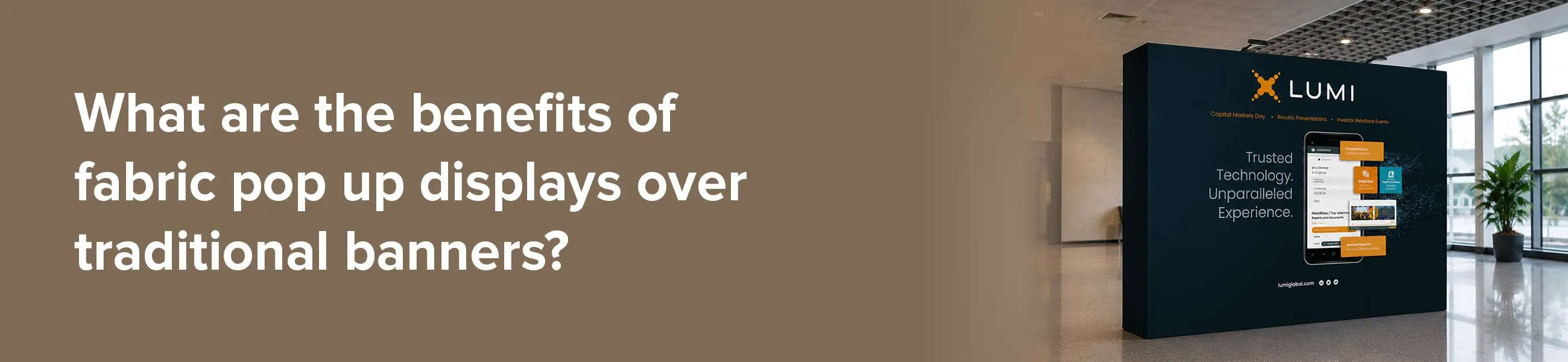
Fabric pop up displays offer richer colour reproduction, a wrinkle-resistant seamless finish, lighter and more compact transport, and better long-term reusability than traditional PVC banners or roll-up stands. For exhibitors at trade shows and exhibitions in Dubai and the UAE, the main benefits of fabric pop up displays are visual quality under venue lighting, faster setup at busy show floors, and a lower cost-per-event when used across multiple exhibitions.
This guide compares fabric pop up displays against traditional banners in detail — covering material differences, visual performance, durability, cost, and which option suits which type of event — so exhibitors in Dubai can make an informed decision before their next trade show.
What Is a Fabric Pop Up Display?
A Fabric pop up display is a collapsible exhibition stand built on a lightweight aluminum frame, covered with a seamless, dye-sublimation printed fabric graphic. The frame expands and locks into a straight or curved wall configuration without tools, and the fabric stretches over the frame to create a smooth, taut, edge-to-edge visual surface.
This differs from a traditional banner, which typically refers to a flat PVC or vinyl sheet — either freestanding on a Roll-up banner stand, hung from grommets, or mounted flat against a wall or frame — printed using solvent or UV ink rather than dye-sublimation.
Both are large-format printed displays used at exhibitions, trade shows, and events across Dubai and the UAE. The difference lies in the material, the printing method, and how each performs under real event conditions.
Why This Comparison Matters for Exhibitors in Dubai
Trade shows at venues like the Dubai World Trade Centre, ADNEC Abu Dhabi, and the Dubai Exhibition Centre are highly competitive visual environments — exhibitors are judged within seconds by visitors walking the aisles. The display material chosen directly affects how professional, vibrant, and durable that first impression is.
Getting this choice wrong has real costs. A banner that creases under transport, fades after a few outdoor uses, or needs replacing after a single event adds up quickly for businesses that exhibit multiple times a year in the UAE. Understanding the benefits of fabric pop up displays compared to traditional banners helps exhibitors avoid these recurring costs and choose the right display for their specific event calendar.
Quick summary: Fabric pop up displays generally outperform traditional banners in visual quality, durability, and reusability — but traditional banners remain a practical, lower-cost option for single-use or outdoor applications. The right choice depends on how often the display will be used and the environment it will be used in.
Fabric Pop Up vs Traditional Banner — Direct Comparison
| Factor | Fabric Pop Up Display | Traditional Banner (PVC/Vinyl) |
|---|---|---|
| Material | Dye-sublimation printed fabric | PVC or vinyl, solvent/UV printed |
| Visual finish | Seamless, matte, no glare | Can show banding, glare under lights |
| Wrinkle resistance | High — stretched taut on frame | Low to moderate — creases when folded |
| Weight | Lighter (typically 8–35 kg depending on size) | Varies; roll-up stands are lightweight, large banners are heavier |
| Setup time | 5–15 minutes, tool-free | 2–10 minutes (roll-up) to longer (eyeletted/hung) |
| Reusability | High — frame reused, graphic replaceable | Lower — PVC degrades faster with repeated folding |
| Outdoor durability | Moderate — best for indoor/sheltered use | High — PVC is more UV and weather resistant |
| Cost per single use | Higher upfront | Lower upfront |
| Cost per event (multi-use) | Lower over time | Higher over time if replaced often |
| Packing size | Compact — collapses into carry case | Compact for roll-ups; bulky for large flat banners |
Key Benefits of Fabric Pop Up Displays Over Traditional Banners
1. Superior Visual Quality Under Exhibition Lighting
Dye-sublimation printing — the process used for fabric pop up graphics — infuses ink directly into the fibres of the fabric rather than sitting on the surface as a coating. This produces deeper colour saturation, sharper detail, and a matte finish that does not glare or reflect under the fluorescent and spotlighting common in Dubai's exhibition halls.
Traditional PVC banners, particularly those printed with solvent ink, can show visible banding in gradients and reflect glare under direct overhead lighting — a noticeable disadvantage when a competing booth's fabric backdrop looks consistently sharp from every angle.
Quick summary: A key benefit of fabric pop up displays is that dye-sublimation printing produces richer, glare-free colour that performs better under typical trade show lighting than standard PVC Banner printing.
2. Seamless, Wrinkle-Resistant Finish
A fabric pop up display is stretched taut across the aluminum frame, eliminating the panel joins, creases, and visible seams that often appear on banners — especially after being folded and transported multiple times.
This matters most for photography. At product launches, press events, and exhibitions where the backdrop appears in every photo, a seamless fabric surface photographs significantly better than a banner with visible fold lines or panel breaks.
Quick summary: One benefit of fabric pop up over traditional banners is the seamless, crease-free surface — which is particularly valuable for backdrops used in event photography and press coverage.
3. Lighter Weight and Easier Transport
Most fabric pop up displays weigh between 8 kg and 35 kg depending on size, and fold compactly into a soft or hardcase carry bag. For exhibitors travelling between venues across Dubai, Abu Dhabi, and the wider UAE — or flying displays between cities — this weight advantage reduces freight cost and makes single-person setup realistic.
Traditional roll-up banners are also lightweight, but larger flat banners (such as those used for backdrop walls) are typically bulkier to transport and require more careful folding to avoid permanent creasing.
4. Faster, Tool-Free Setup at Busy Trade Shows
Fabric pop up frames use a collapsible aluminum structure that expands and locks into position without tools — typically assembled in 5 to 15 minutes by one person. This is a meaningful advantage at trade shows in Dubai where exhibitor move-in windows are tightly scheduled and booth teams often have limited time to set up before doors open.
Roll-up banners are also fast to deploy, but larger backdrop-style banners that require eyelet fixing, pole pockets, or wall mounting generally take longer and may require two people.
5. Better Long-Term Reusability and Lower Cost-Per-Event
This is one of the most practical benefits of fabric pop up displays for businesses that exhibit regularly. The aluminum frame is designed for repeated assembly and disassembly across multiple events, and the fabric graphic can be replaced independently of the frame when a new campaign or design is needed.
For an exhibitor attending four or more trade shows a year in Dubai and the UAE, this reusability typically results in a lower cost-per-event over time compared to ordering new PVC banners for each show — even though the upfront cost of a fabric pop up display is generally higher.
| Usage Pattern | Better Option |
|---|---|
| Single one-off event | Traditional banner (lower upfront cost) |
| 3+ events per year | Fabric pop up display (lower cost-per-event over time) |
| Outdoor, exposed conditions | Traditional PVC banner (more weather resistant) |
| Indoor exhibitions, conferences | Fabric pop up display (better visual quality) |
| Press/photography backdrop | Fabric pop up display (seamless, glare-free) |
| Tight budget, short notice | Traditional banner (faster to produce cheaply) |
6. More Design Flexibility — Straight and Curved Configurations
Fabric pop up displays are available in both straight and curved frame configurations, allowing exhibitors to create a flat back wall or a more immersive, enclosing curved booth shape. Traditional banners are limited to flat presentation unless mounted on a specifically curved structure, which adds cost and complexity that pop up systems handle natively.
Where Traditional Banners Still Make Sense
Fabric pop up displays are not the better choice in every scenario. Traditional PVC banners remain the more practical option in specific situations:
- Outdoor events and exhibitions — PVC is more resistant to UV exposure, rain, and temperature swings than fabric, which is generally recommended for indoor or sheltered use
- One-time or short-notice events — if a display is needed once and the budget is tight, a printed banner is typically faster and cheaper to produce
- Construction hoardings, fences, and large-scale outdoor branding — flex and mesh banners are purpose-built for these high-durability, low-frequency-use applications
- Very large format displays — extremely wide backdrop walls (6m and above) can be more economical in flex banner form than fabric in some cases, depending on supplier pricing
Quick summary: Traditional banners are still the right choice for outdoor, one-off, or very large-format applications where weather resistance and low upfront cost matter more than visual finish or reusability.
How Fabric Pop Up Displays Work — A Closer Look
The Frame System
A fabric pop up frame is made from lightweight aluminum tubing, typically pre-assembled into sections that unfold and lock into a rigid standing structure. Most systems are tool-free — the frame self-supports once expanded, similar in principle to a tent pole system but engineered for repeated commercial use.
The Graphic Application
The fabric graphic is produced using dye-sublimation printing, where heat transfers dye into polyester fabric fibres. Once printed, the fabric is sewn with a tensioning system — often a zippered or sleeved edge — that pulls it taut over the frame, eliminating slack and creating the smooth, seamless surface fabric pop up displays are known for.
Configurations Available
- Straight pop up walls — flat back wall displays, the most common configuration for shell scheme booths
- Curved pop up walls — create a more enclosing, immersive booth shape
- Tabletop pop up units — smaller versions for counters and registration desks
- Combination kits — pop up walls paired with literature stands, counters, or lighting
Best Practices When Choosing Between Fabric Pop Up and Traditional Banners
Expert tip: Match the display type to your event frequency, not just your budget. Businesses often default to the cheapest option per event without calculating the cost-per-use across a full exhibition calendar — which frequently favours fabric pop up displays once three or more events are factored in.
- Calculate your annual event count first. If exhibiting at three or more trade shows per year in Dubai or across the UAE, the reusability of a fabric pop up display generally offsets the higher upfront cost within the first year
- Match the display to the venue environment. Choose fabric for indoor exhibitions and conferences; choose PVC banners for outdoor or exposed locations
- Consider photography needs. If the display will feature heavily in event photography or press coverage, the seamless finish of fabric pop up displays is a meaningful visual advantage
- Check booth allocation size before ordering. Pop up displays are sized using a width × height grid system (such as 3×3 or 4×3) and should be matched to the exhibitor's shell scheme allocation
- Ask suppliers about graphic replacement options. Key advantage of fabric pop up systems is that the frame can be reused with a new graphic — confirm this is offered before purchasing
Practical Example: Choosing Between Fabric Pop Up and Banners for a Dubai Trade Show
A UAE-based technology company exhibits at four trade shows annually across Dubai and Abu Dhabi, including GITEX. For their first event, they ordered a printed PVC roll-up banner — a low upfront cost, fast turnaround solution. By the third event, the banner had visible crease lines from repeated folding and required reprinting, adding unplanned cost.
For their next exhibition cycle, the company switched to a 3×3 fabric pop up display. The aluminum frame has been reused across four subsequent events, with only the fabric graphic replaced once when their branding updated. Over a year, the total cost per event was lower than the banner-replacement cycle — while the seamless Fabric backdrop also performed better in the company's press and social media photography from each event.
This example reflects a common pattern among regular UAE exhibitors: traditional banners suit the first event or occasional use, while fabric pop up displays become more cost-effective and visually consistent as event frequency increases.
Where to Source Fabric Pop Up Displays in Dubai and the UAE
For exhibitors comparing fabric pop up displays against traditional banners ahead of a trade show in Dubai, Abu Dhabi, or elsewhere in the UAE, Deluxe Printing produces both formats—including straight and curved fabric pop up walls, softcase and hardcase packaging options, and traditional flex and PVC banners for outdoor or one-off applications.
With over 25 years of experience supplying exhibition displays across the UAE, the Deluxe team can advise on which format suits a specific event frequency, venue, and budget and can produce replacement fabric graphics for existing pop up frames without requiring a full system reorder.
Fabric Pop Up Displays vs Traditional Banners
Fabric pop up displays offer clear advantages over traditional banners in visual quality, wrinkle resistance, transport weight, setup speed, and long-term reusability — making them the stronger choice for exhibitors attending multiple events per year, particularly indoors. Traditional PVC banners remain the better option for outdoor applications, one-off events, and situations where minimising upfront cost is the priority. The right decision depends on event frequency, venue environment, and whether the display needs to perform well in photography.
Key Takeaways
- Fabric pop up displays use dye-sublimation printing for richer, glare-free colour compared to standard PVC banner printing
- The seamless, taut fabric surface resists wrinkles and panel-join lines — a meaningful benefit for displays used as photography backdrops
- Fabric pop up systems are generally lighter and pack more compactly than large traditional banners, easing transport across UAE venues
- Setup is typically tool-free and takes 5–15 minutes, suited to the tight move-in windows common at Dubai trade shows
- Reusability is the biggest cost advantage — the frame is reused across events, with only the graphic replaced, lowering cost-per-event for exhibitors attending 3+ shows a year
- Traditional banners remain the better choice for outdoor exhibitions, one-off events, and budget-constrained, short-notice orders
- The decision between fabric pop up and traditional banners should be based on event frequency and venue environment, not upfront cost alone
FAQs
Contact Deluxe Printing
- Al Qusais Industrial Area 2 is located in Dubai, UAE
- Call us on +971 4272 5202
- Email: print@dlxprint.com